About This Course
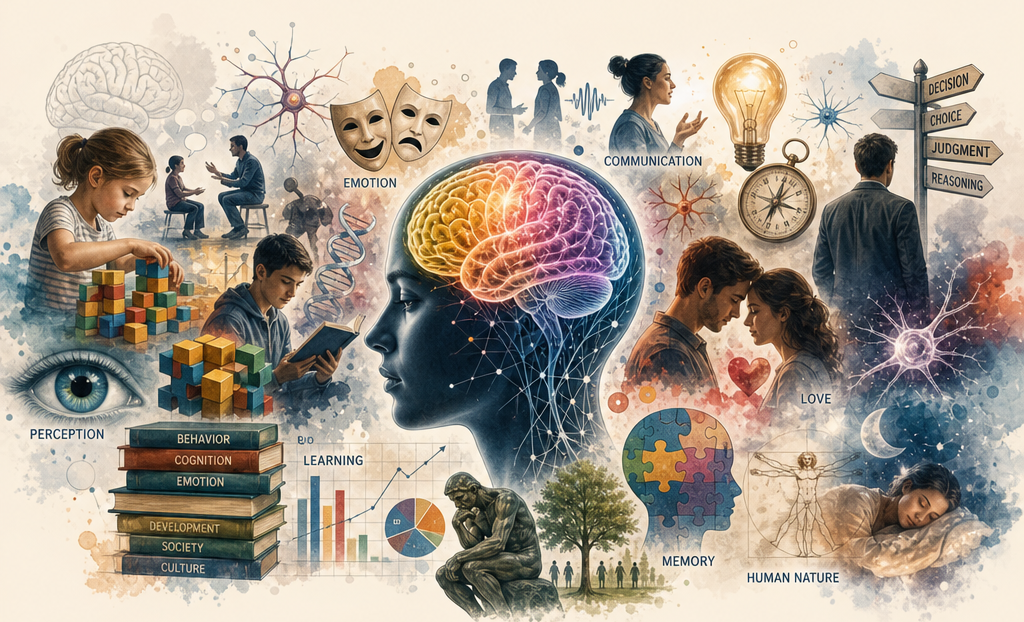
Yale’s Introduction to Psychology is one of the most celebrated open courses in the world — and for good reason. It tackles the biggest questions about how the mind works, why we behave the way we do, and what science reveals about our thoughts, emotions, and decisions. From dreams to memory, persuasion to morality, hunger to love, this course explores the full spectrum of human experience through clear, engaging, and often surprising scientific explanations. The topics mirror the course’s own description: perception, communication, learning, memory, decision‑making, religion, persuasion, love, lust, hunger, art, fiction, and dreams.
Led by Professor Paul Bloom — a renowned cognitive scientist whose work appears in Nature, Science, The New York Times, and The Atlantic — the course blends cutting‑edge research with real‑world examples that make psychology feel immediately relevant. You’ll learn how children develop their understanding of the world, how the brain wires itself for perception and emotion, and how mental processes break down due to illness or injury. Current page. We will look at how these aspects of the mind develop in children, how they differ across people, how they are wired up.... You’ll also explore how people make choices, why we’re influenced by stories and art, and what science says about religion, morality, and human relationships.
What makes this course especially powerful today is how directly it connects to your everyday life. You’ll understand why you remember some things and forget others, why persuasion works, why you feel hungry, why fiction moves you, and even why you can’t tickle yourself. These insights aren’t just interesting — they’re transformative. They help you understand yourself, your relationships, and the world around you with new clarity.
Even better, mastering this material positions you to earn 3 college credits through the CLEP Introductory Psychology exam or the AP Psychology exam. Whether you’re a high‑school student accelerating your degree, a college learner strengthening your foundation, or a lifelong learner exploring the mind, this course gives you both intellectual depth and practical value.
Yale’s Introduction to Psychology remains one of the most engaging, accessible, and thought‑provoking ways to explore the science of human behavior — and now it can help you earn real college credit too.
Course Staff
Chief Educational Troublemaker
Michael Williams
Michael Williams is the Chief Educational Troublemaker at World Mentoring Academy — a title he earned the hard way: by spending more than a decade poking, prodding, and occasionally drop‑kicking the traditional education system into the future. In 2010, long before “MOOC” became a Silicon Valley buzzword, Michael was building a free global college from a backpack, a stubborn belief in open learning, and whatever Starbucks Wi‑Fi he could borrow. The Orange County Register profiled him as a “homeless by choice educator to the world,” documenting his 12‑hour days assembling university‑level courses from MIT, Yale, NPTEL, and Stanford — all without charging a cent.
While the big platforms eventually traded “open” for “subscription,” Michael never budged. World Mentoring Academy remains one of the last true free MOOCs on Earth, offering more than 1,000 courses without paywalls, upsells, or fine print.
Michael’s LinkedIn essays — including “Harvard & MIT, Follow a Homeless Educator,” “The Future Won’t Wait for Academia,” and “Future of Education May Have Ancient Roots?” — have earned him a reputation as a futurist with calluses, someone who can explain why AI is breaking the job market, why teens are the workforce pipeline no one is using, and why the next education revolution will look more like ancient Athens than a modern lecture hall.
Across every WMA course, Michael appears as your unofficial guide, mentor, instigator, and occasionally your friendly academic arsonist — the guy who hands you the map, the compass, and the confidence to build a future that doesn’t depend on debt, gatekeeping, or waiting for institutions to catch up.
He helps learners find their place in a world that’s changing faster than universities can update their syllabi — and he does it with humor, humanity, and a refusal to accept that opportunity should be rationed.
If education needs a troublemaker, Michael is happy to volunteer.