About This Course
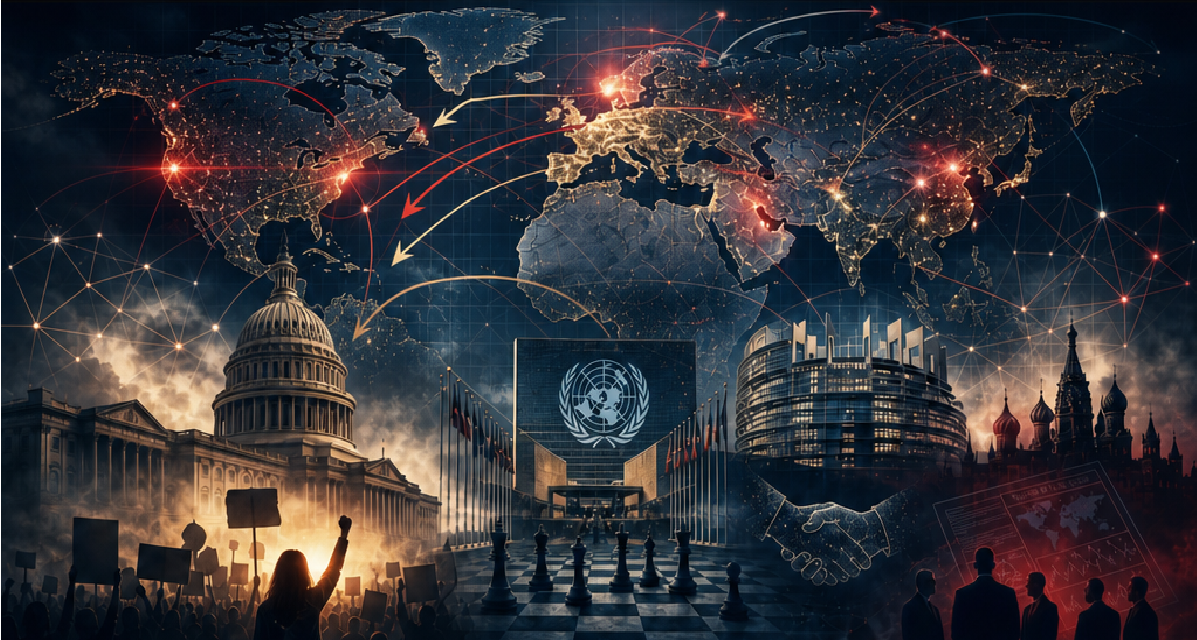
This course invites students to step inside the engine room of global politics and examine how power has shifted over the past quarter century—and what those changes mean for the future. From the decline of trade unions and the rise of corporate influence to the spread of new authoritarian movements and the fragility of democratic institutions, students explore the forces reshaping governance, inequality, and civic life across nations.
Through dynamic lectures and discussions, learners analyze the transformation of political parties, the erosion of middle‑class security, and the widening gap between economic elites and everyday citizens. The course also investigates the durability of the unipolar international order that emerged after the Cold War, asking whether the United States can sustain its leadership amid global realignments and domestic polarization.
Students engage directly with contemporary case studies—examining elections, protests, policy reforms, and international negotiations—to understand how political institutions adapt or fail under pressure. The emphasis is on critical evaluation: identifying patterns of power, tracing accountability, and imagining new models of governance that can respond to inequality and insecurity.
Experiential learning is central. Field trips may include visits to local government offices, civic organizations, and policy think tanks, where students meet practitioners who shape public debate. Volunteer opportunities connect classroom theory to real‑world civic engagement—students might assist voter‑education drives, community advocacy groups, or social‑service initiatives addressing inequality and environmental justice.
By the end of the course, participants will have a nuanced understanding of how power operates in today’s world—who wields it, who resists it, and how institutions evolve under strain. They will leave equipped not only with analytical tools but with a sense of civic responsibility and the confidence to participate meaningfully in public life.
This is a course for students who want to understand the world as it is—and help shape what comes next.
Course Staff
Chief Educational Troublemaker
Michael Williams
Michael Williams is the Chief Educational Troublemaker at World Mentoring Academy — a title he earned the hard way: by spending more than a decade poking, prodding, and occasionally drop‑kicking the traditional education system into the future. In 2010, long before “MOOC” became a Silicon Valley buzzword, Michael was building a free global college from a backpack, a stubborn belief in open learning, and whatever Starbucks Wi‑Fi he could borrow. The Orange County Register profiled him as a “homeless by choice educator to the world,” documenting his 12‑hour days assembling university‑level courses from MIT, Yale, NPTEL, and Stanford — all without charging a cent.
While the big platforms eventually traded “open” for “subscription,” Michael never budged. World Mentoring Academy remains one of the last true free MOOCs on Earth, offering more than 1,000 courses without paywalls, upsells, or fine print.
Michael’s LinkedIn essays — including “Harvard & MIT, Follow a Homeless Educator,” “The Future Won’t Wait for Academia,” and “Future of Education May Have Ancient Roots?” — have earned him a reputation as a futurist with calluses, someone who can explain why AI is breaking the job market, why teens are the workforce pipeline no one is using, and why the next education revolution will look more like ancient Athens than a modern lecture hall.
Across every WMA course, Michael appears as your unofficial guide, mentor, instigator, and occasionally your friendly academic arsonist — the guy who hands you the map, the compass, and the confidence to build a future that doesn’t depend on debt, gatekeeping, or waiting for institutions to catch up.
He helps learners find their place in a world that’s changing faster than universities can update their syllabi — and he does it with humor, humanity, and a refusal to accept that opportunity should be rationed.
If education needs a troublemaker, Michael is happy to volunteer.