About This Course
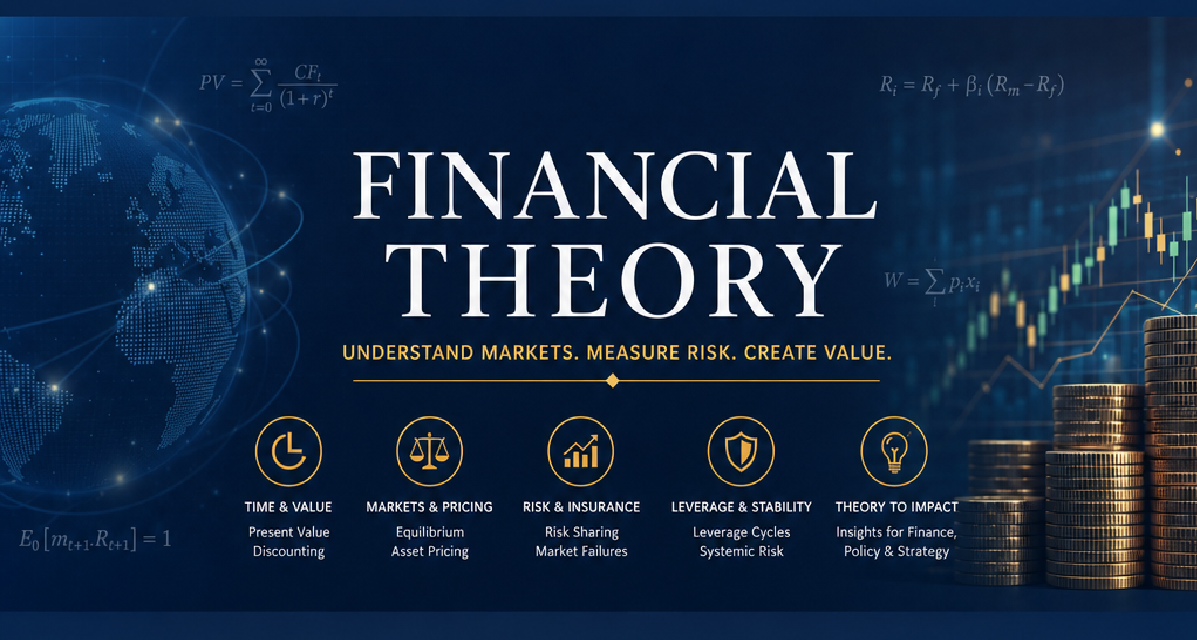
Financial Theory introduces learners to the deep logic that underpins modern financial markets, revealing why people trade, how prices emerge, and what risk truly means. Guided by Yale economist John Geanakoplos, this course blends mathematical clarity with intuitive storytelling, helping you see finance not as a collection of formulas but as a coherent system of incentives, expectations, and strategic behavior.
You begin with the foundations: present value, discounting, and the idea that all financial decisions revolve around time, uncertainty, and trade-offs. From there, the course moves into general equilibrium theory, showing how markets coordinate millions of individual decisions into a single price system. You explore arbitrage, market completeness, and the conditions under which markets allocate resources efficiently — and the many real-world cases where they do not.
A major emphasis is placed on risk and insurance, including how individuals and institutions share risk, why markets sometimes fail to provide adequate insurance, and how financial innovation attempts to fill those gaps. You’ll examine asset pricing models, from the Capital Asset Pricing Model (CAPM) to Arrow–Debreu securities, and learn how these frameworks explain returns, volatility, and investor behavior.
The course also explores leverage cycles, a signature contribution of Geanakoplos. You’ll see how borrowing expands and contracts through the economy, why leverage amplifies booms and busts, and how collateral requirements shape systemic stability. These insights connect directly to the 2008 financial crisis and continue to influence macro‑financial policy today.
By the end, you’ll understand not only how financial markets work, but why they sometimes break — and what tools economists use to analyze, predict, and mitigate those failures. Whether you’re preparing for a career in finance, economics, policy, or data‑driven decision‑making, this course builds the analytical intuition that separates competent practitioners from strategic thinkers.
Course Staff
Chief Educational Troublemaker
Michael Williams
Michael Williams is the Chief Educational Troublemaker at World Mentoring Academy — a title he earned the hard way: by spending more than a decade poking, prodding, and occasionally drop‑kicking the traditional education system into the future. In 2010, long before “MOOC” became a Silicon Valley buzzword, Michael was building a free global college from a backpack, a stubborn belief in open learning, and whatever Starbucks Wi‑Fi he could borrow. The Orange County Register profiled him as a “homeless-by-choice educator to the world,” documenting his 12‑hour days assembling university‑level courses from MIT, Yale, NPTEL, and Stanford — all without charging a cent.
While the big platforms eventually traded “open” for “subscription,” Michael never budged. World Mentoring Academy remains one of the last true free MOOCs on Earth, offering more than 1,000 courses without paywalls, upsells, or fine print.
Michael’s LinkedIn essays — including “Harvard & MIT, Follow a Homeless Educator,” “The Future Won’t Wait for Academia,” and “Future of Education May Have Ancient Roots?” — have earned him a reputation as a futurist with calluses, someone who can explain why AI is breaking the job market, why teens are the workforce pipeline no one is using, and why the next education revolution will look more like ancient Athens than a modern lecture hall.
Across every WMA course, Michael appears as your unofficial guide, mentor, instigator, and occasionally your friendly academic arsonist — the guy who hands you the map, the compass, and the confidence to build a future that doesn’t depend on debt, gatekeeping, or waiting for institutions to catch up.
He helps learners find their place in a world that’s changing faster than universities can update their syllabi — and he does it with humor, humanity, and a refusal to accept that opportunity should be rationed.
If education needs a troublemaker, Michael is happy to volunteer.