About This Course
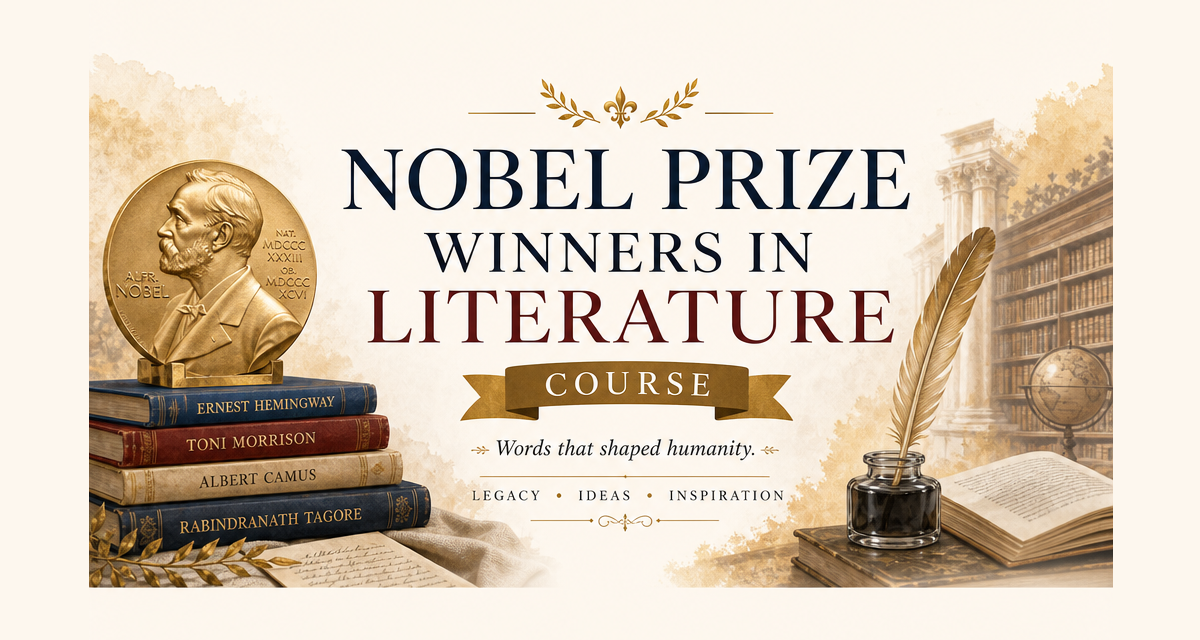
The Nobel Prize in Literature honors writers whose words have transformed culture, challenged societies, and expanded our understanding of the human experience. This course invites you into that world — a journey through the novels, poems, essays, and plays that have defined generations. Designed for curious readers, lifelong learners, and self‑improvers who want to deepen their literary insight, the course blends historical context, close reading, and thematic exploration to illuminate why these authors continue to matter.
You’ll study a diverse range of laureates from around the globe — from the philosophical clarity of Albert Camus to the lyrical power of Toni Morrison, the political courage of Nadine Gordimer, the mythic storytelling of Gabriel García Márquez, the sharp humanism of Rabindranath Tagore, and the bold experimentation of Kazuo Ishiguro. Each module explores the writer’s life, cultural background, major works, and the reasons the Nobel Committee recognized their contribution to world literature.
The course provides a rich set of learning resources: author profiles, guided reading notes, thematic breakdowns, historical timelines, video lectures, and curated excerpts that highlight each writer’s craft. You’ll examine how Nobel authors confront universal themes — identity, justice, memory, love, war, exile, freedom, and the search for meaning — and how their voices continue to resonate across borders and generations.
You’ll also explore the evolution of the Nobel Prize itself: its origins, its controversies, its shifting global focus, and its role in shaping literary canon. Through discussions and reflective prompts, you’ll consider what makes literature “prize‑worthy,” how cultural values influence recognition, and how global storytelling continues to evolve.
What truly elevates this course is the community of readers you join. You’ll be part of a vibrant group of learners who love books, ideas, and meaningful conversation. Together, you’ll share interpretations, debate themes, explore cultural perspectives, and discover new authors who challenge and inspire you. This is a space where thoughtful reading becomes a shared journey — where beginners feel welcomed, experienced readers feel enriched, and everyone grows through dialogue.
Whether you’re expanding your literary horizons, seeking deeper cultural understanding, or simply wanting to read more intentionally, this course gives you the structure, insight, and inspiration to engage with some of the greatest writers in history. Step into the world of Nobel literature — and let these extraordinary voices expand your own.
This is paragraph 2 of the long course description. Add more paragraphs as needed. Make sure to enclose them in paragraph tags.
Course Staff
Chief Educational Troublemaker
Michael Williams
Michael Williams is the Chief Educational Troublemaker at World Mentoring Academy — a title he earned the hard way: by spending more than a decade poking, prodding, and occasionally drop‑kicking the traditional education system into the future. In 2010, long before “MOOC” became a Silicon Valley buzzword, Michael was building a free global college from a backpack, a stubborn belief in open learning, and whatever Starbucks Wi‑Fi he could borrow. The Orange County Register profiled him as a “homeless-by-choice educator to the world,” documenting his 12‑hour days assembling university‑level courses from MIT, Yale, NPTEL, and Stanford — all without charging a cent.
While the big platforms eventually traded “open” for “subscription,” Michael never budged. World Mentoring Academy remains one of the last true free MOOCs on Earth, offering more than 1,000 courses without paywalls, upsells, or fine print.
Michael’s LinkedIn essays — including “Harvard & MIT, Follow a Homeless Educator,” “The Future Won’t Wait for Academia,” and “Future of Education May Have Ancient Roots?” — have earned him a reputation as a futurist with calluses, someone who can explain why AI is breaking the job market, why teens are the workforce pipeline no one is using, and why the next education revolution will look more like ancient Athens than a modern lecture hall.
Across every WMA course, Michael appears as your unofficial guide, mentor, instigator, and occasionally your friendly academic arsonist — the guy who hands you the map, the compass, and the confidence to build a future that doesn’t depend on debt, gatekeeping, or waiting for institutions to catch up.
He helps learners find their place in a world that’s changing faster than universities can update their syllabi — and he does it with humor, humanity, and a refusal to accept that opportunity should be rationed.
If education needs a troublemaker, Michael is happy to volunteer.