Abnormal Psychology

UC_Berkeley

About This Course

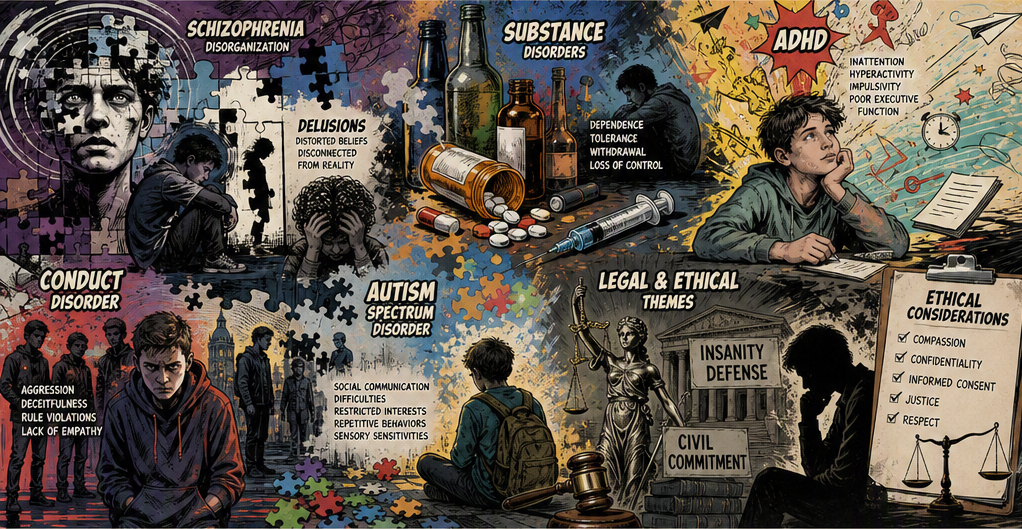
Studying this course gives you a rare, panoramic understanding of how the mind works—across biology, behavior, development, culture, and the law. You don’t just memorize diagnostic criteria; you learn how disorders emerge, why they persist, and how people can be helped through evidence‑based treatment. The lectures move from schizophrenia to ADHD, substance use, autism, conduct disorder, and legal/ethical issues, giving you a complete map of modern clinical psychology.

You’ll explore real case studies—people navigating hallucinations, delusions, addiction, childhood behavioral challenges, and complex family dynamics. These aren’t abstract textbook examples; they’re vivid, human stories that make the science unforgettable. You’ll also learn how genetics, brain development, neurotransmitters, and environmental stress shape mental illness, and why treatments like CBT, medication, parent‑training, and multisystemic therapy work.

Another major benefit is the course’s emphasis on critical thinking. You learn to evaluate research, understand correlation vs. causation, and spot common misconceptions about mental illness. You’ll leave with sharper reasoning skills that apply far beyond psychology—useful in medicine, law, education, public policy, and everyday life.

The course also challenges stigma. You’ll come away with a deeper appreciation for the courage of people living with mental illness and a clearer sense of how society can support them. Whether you pursue psychology professionally or simply want to be a more informed, compassionate human being, this course gives you tools to understand and help others.

Finally, the class builds a sense of community. The material is rich, emotional, and intellectually demanding—perfect for discussion, debate, and collaborative learning. Study groups often become supportive spaces where students unpack complex topics, compare notes, and help each other prepare for exams.

Requirements

Add information about the skills and knowledge students need to take this course.

Course Staff


Chief Educational Troublemaker

Michael Williams

Michael Williams is the Chief Educational Troublemaker at World Mentoring Academy — a title he earned the hard way: by spending more than a decade poking, prodding, and occasionally drop‑kicking the traditional education system into the future. In 2010, long before “MOOC” became a Silicon Valley buzzword, Michael was building a free global college from a backpack, a stubborn belief in open learning, and whatever Starbucks Wi‑Fi he could borrow. The Orange County Register profiled him as a “homeless by choice educator to the world,” documenting his 12‑hour days assembling university‑level courses from MIT, Yale, NPTEL, and Stanford — all without charging a cent.
While the big platforms eventually traded “open” for “subscription,” Michael never budged. World Mentoring Academy remains one of the last true free MOOCs on Earth, offering more than 1,000 courses without paywalls, upsells, or fine print.
Michael’s LinkedIn essays — including “Harvard & MIT, Follow a Homeless Educator,” “The Future Won’t Wait for Academia,” and “Future of Education May Have Ancient Roots?” — have earned him a reputation as a futurist with calluses, someone who can explain why AI is breaking the job market, why teens are the workforce pipeline no one is using, and why the next education revolution will look more like ancient Athens than a modern lecture hall.
Across every WMA course, Michael appears as your unofficial guide, mentor, instigator, and occasionally your friendly academic arsonist — the guy who hands you the map, the compass, and the confidence to build a future that doesn’t depend on debt, gatekeeping, or waiting for institutions to catch up.
He helps learners find their place in a world that’s changing faster than universities can update their syllabi — and he does it with humor, humanity, and a refusal to accept that opportunity should be rationed.
If education needs a troublemaker, Michael is happy to volunteer.

Frequently Asked Questions

What web browser should I use?

The Open edX platform works best with current versions of Chrome, Edge, Firefox, or Safari.

See our list of supported browsers for the most up-to-date information.

Question #2

Your answer would be displayed here.

Enroll