About This Course
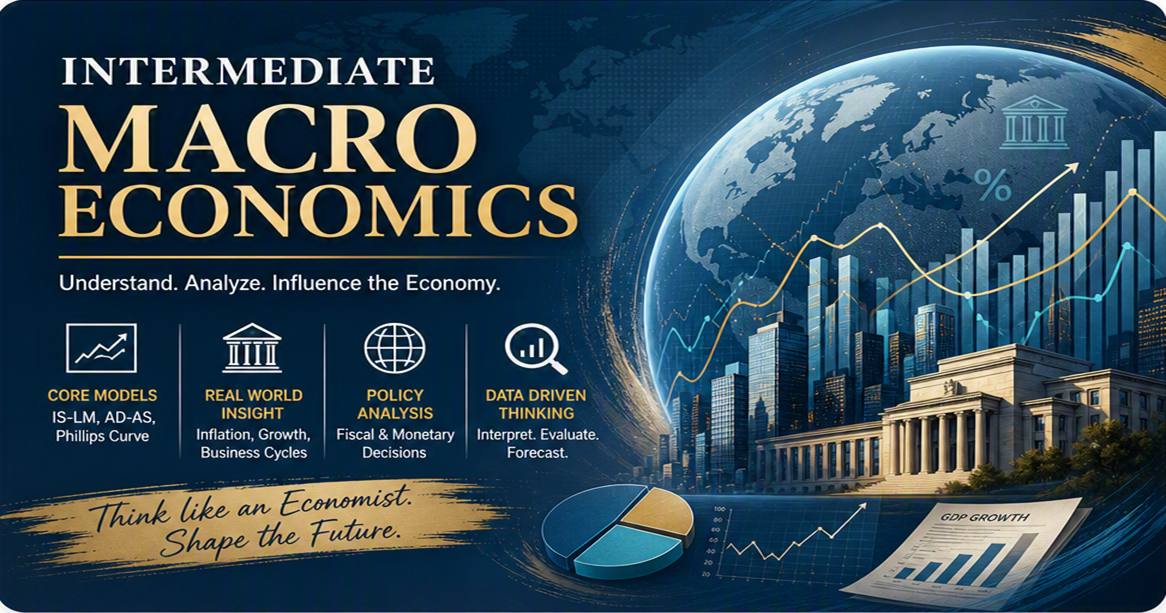
Intermediate Macroeconomics is the course that finally reveals how the economic world actually works. If you’ve ever wondered why recessions happen, why inflation rises and falls, why governments argue endlessly about deficits, or why financial markets react instantly to political news, this course gives you the tools to understand it—not as a spectator, but as someone who can analyze, interpret, and explain the forces shaping the global economy.
You’ll learn the core models economists use to decode real events: the income‑expenditure framework that shows how spending drives output; the IS‑LM system that explains interest rates and investment; the Phillips Curve that links unemployment and inflation; and the long‑run growth equations that determine living standards across generations. These aren’t abstract theories—they’re the same tools used by central banks, governments, and financial institutions to make trillion‑dollar decisions.
What makes Intermediate Macroeconomics exciting is how directly it connects to the world around you. Every week, you’ll see headlines about inflation, interest‑rate changes, budget battles, or global financial stress—and you’ll understand exactly what they mean. You’ll be able to evaluate whether a policy proposal makes sense, whether a forecast is realistic, and whether a politician’s economic claims hold up under scrutiny. You’ll gain the ability to translate complex economic dynamics into clear, logical explanations that others can understand.
This course also builds powerful analytical skills. You’ll learn to work with equations that describe how economies behave, calculate multipliers and output gaps, forecast growth paths, and assess fiscal sustainability. These skills matter whether you’re heading into economics, public policy, finance, data science, or any field that requires understanding how large systems respond to shocks and incentives.
Most importantly, Intermediate Macroeconomics teaches you how to think like an economist—how to break down complicated problems, identify the key forces at work, and reason from first principles. It’s a course that sharpens your mind, expands your perspective, and gives you a framework for understanding the biggest challenges facing societies today.
If you want to understand the world—not just watch it—this is the course to take.
Course Staff
Chief Educational Troublemaker
Michael Williams
Michael Williams is the Chief Educational Troublemaker at World Mentoring Academy — a title he earned the hard way: by spending more than a decade poking, prodding, and occasionally drop‑kicking the traditional education system into the future. In 2010, long before “MOOC” became a Silicon Valley buzzword, Michael was building a free global college from a backpack, a stubborn belief in open learning, and whatever Starbucks Wi‑Fi he could borrow. The Orange County Register profiled him as a “homeless by choice educator to the world,” documenting his 12‑hour days assembling university‑level courses from MIT, Yale, NPTEL, and Stanford — all without charging a cent.
While the big platforms eventually traded “open” for “subscription,” Michael never budged. World Mentoring Academy remains one of the last true free MOOCs on Earth, offering more than 1,000 courses without paywalls, upsells, or fine print.
Michael’s LinkedIn essays — including “Harvard & MIT, Follow a Homeless Educator,” “The Future Won’t Wait for Academia,” and “Future of Education May Have Ancient Roots?” — have earned him a reputation as a futurist with calluses, someone who can explain why AI is breaking the job market, why teens are the workforce pipeline no one is using, and why the next education revolution will look more like ancient Athens than a modern lecture hall.
Across every WMA course, Michael appears as your unofficial guide, mentor, instigator, and occasionally your friendly academic arsonist — the guy who hands you the map, the compass, and the confidence to build a future that doesn’t depend on debt, gatekeeping, or waiting for institutions to catch up.
He helps learners find their place in a world that’s changing faster than universities can update their syllabi — and he does it with humor, humanity, and a refusal to accept that opportunity should be rationed.
If education needs a troublemaker, Michael is happy to volunteer.