About This Course
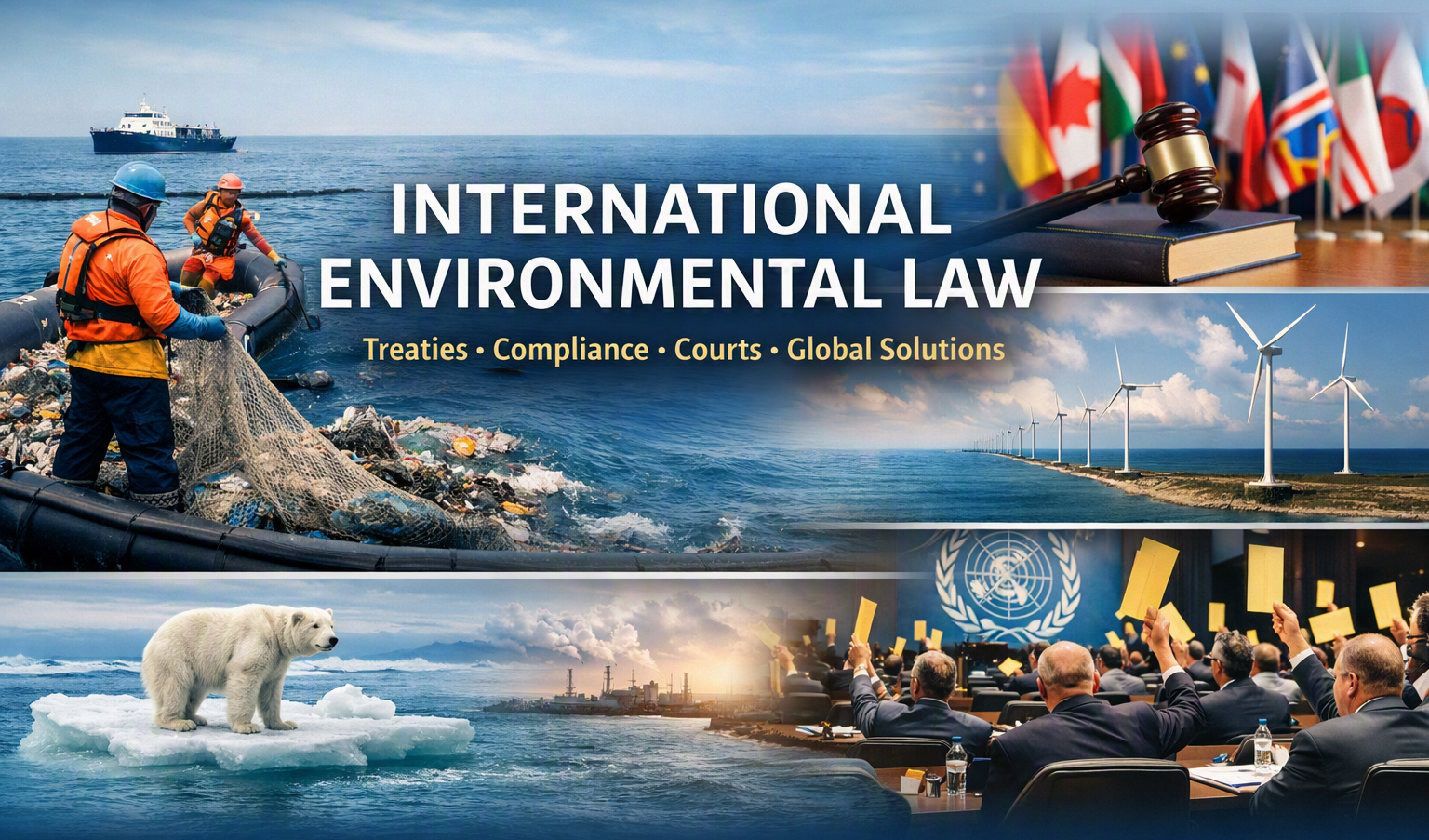
International environmental law isn’t abstract theory — it’s the legal architecture that determines how nations protect ecosystems, manage shared resources, respond to disasters, and negotiate the future of the planet. This course gives students, professionals, policymakers, advocates, and globally minded thinkers the rare chance to understand that architecture from the inside.
Across the semester, you explore the real machinery of international law: how treaties are negotiated, how states comply (or don’t), how domestic courts influence global norms, and how institutions like the WTO, UN, and specialized treaty bodies actually function. You learn why some agreements succeed, why others stall, and how political realities, scientific uncertainty, and legal design collide in every major environmental challenge — from biodiversity loss to climate change, transboundary pollution, resource extraction, and environmental emergencies.
What makes this course uniquely valuable is its practical lens. You don’t just read treaties; you analyze how they operate in the real world. You examine compliance frameworks, dispute settlement systems, and the evolving relationship between domestic and international courts. You learn how environmental norms migrate across borders, how “soft law” becomes “hard law,” and how legal innovations — emissions trading, public participation rights, liability regimes, scientific advisory bodies — reshaped global governance over the last 30 years.
You also gain hands‑on experience: presenting treaty analyses, drafting legal language, evaluating institutional design, and understanding how lawyers actually use international law to achieve environmental outcomes. The course demystifies complex systems like the Antarctic Treaty, CITES, climate agreements, regional seas conventions, and trade‑environment disputes. You see how environmental protection intersects with sovereignty, economics, human rights, and geopolitics.
This course is ideal for law students, policy students, environmental scientists, NGO advocates, government staff, international relations majors, and anyone who wants to work in global sustainability, climate policy, conservation, or international governance. It’s also perfect for professionals transitioning into environmental or international work who need a clear, structured understanding of how global rules are made, interpreted, and enforced.
If you want to understand the legal forces shaping the planet’s future — and learn how to use them — this course gives you the insight, tools, and strategic awareness to do it.
Course Staff
Chief Educational Troublemaker
Michael Williams
Michael Williams is the Chief Educational Troublemaker at World Mentoring Academy — a title he earned the hard way: by spending more than a decade poking, prodding, and occasionally drop‑kicking the traditional education system into the future. In 2010, long before “MOOC” became a Silicon Valley buzzword, Michael was building a free global college from a backpack, a stubborn belief in open learning, and whatever Starbucks Wi‑Fi he could borrow. The Orange County Register profiled him as a “homeless by choice educator to the world,” documenting his 12‑hour days assembling university‑level courses from MIT, Yale, NPTEL, and Stanford — all without charging a cent.
While the big platforms eventually traded “open” for “subscription,” Michael never budged. World Mentoring Academy remains one of the last true free MOOCs on Earth, offering more than 1,000 courses without paywalls, upsells, or fine print.
Michael’s LinkedIn essays — including “Harvard & MIT, Follow a Homeless Educator,” “The Future Won’t Wait for Academia,” and “Future of Education May Have Ancient Roots?” — have earned him a reputation as a futurist with calluses, someone who can explain why AI is breaking the job market, why teens are the workforce pipeline no one is using, and why the next education revolution will look more like ancient Athens than a modern lecture hall.
Across every WMA course, Michael appears as your unofficial guide, mentor, instigator, and occasionally your friendly academic arsonist — the guy who hands you the map, the compass, and the confidence to build a future that doesn’t depend on debt, gatekeeping, or waiting for institutions to catch up.
He helps learners find their place in a world that’s changing faster than universities can update their syllabi — and he does it with humor, humanity, and a refusal to accept that opportunity should be rationed.
If education needs a troublemaker, Michael is happy to volunteer.