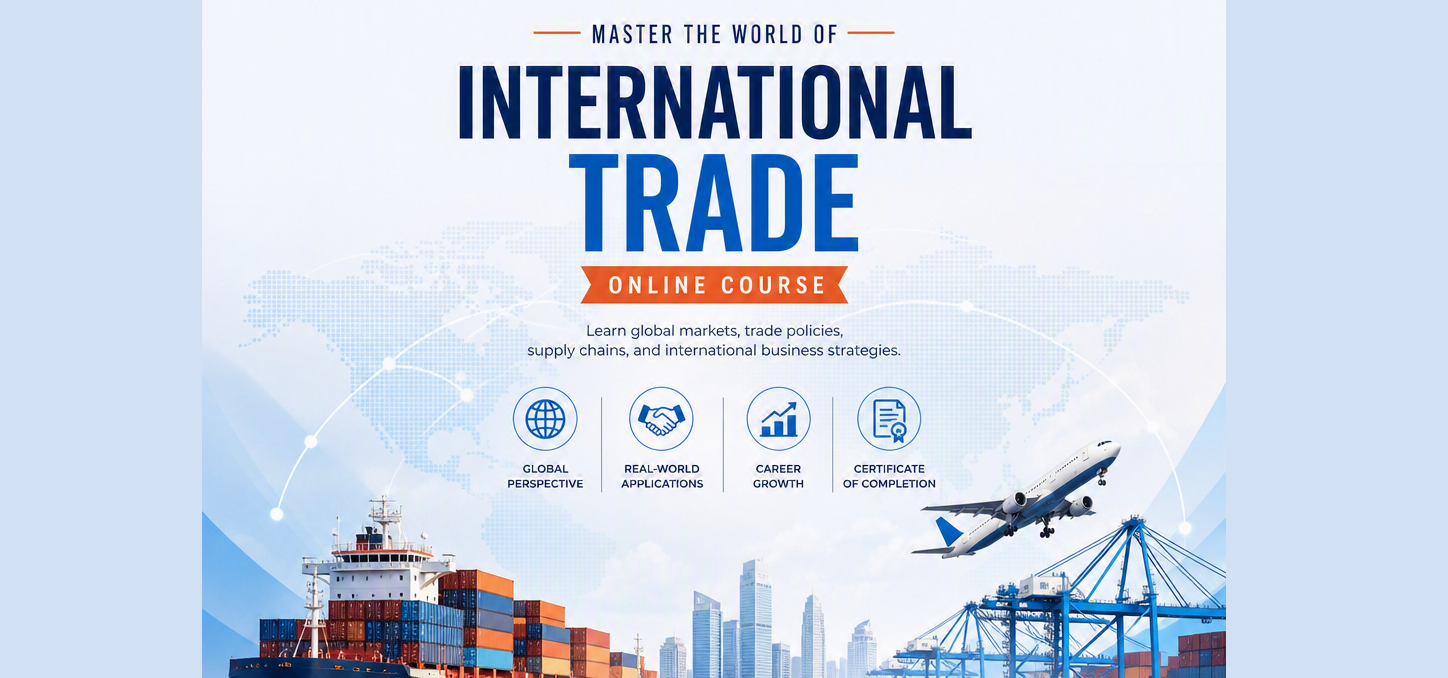
About This Course
International trade isn’t just an academic subject—it’s the engine behind modern prosperity, global competition, and the strategic choices that shape nations. Taking this course gives you the ability to understand why countries trade, how industries rise or fall, and what policies determine who wins in the global marketplace. If you want to understand the world’s economic pulse, this course is essential.
You’ll explore the foundational models—comparative advantage, Heckscher‑Ohlin, and the standard trade framework—that explain why trade creates wealth and how nations specialize. But you’ll go far beyond the basics. You’ll learn how economies of scale, monopolistic competition, and external economies transform entire industries, from Hollywood to Silicon Valley to global manufacturing hubs. You’ll see why some countries dominate certain sectors for centuries, and why others struggle to break in even when they have a cost advantage.
Trade policy becomes real and tangible here. Tariffs, quotas, export subsidies, and voluntary export restraints aren’t abstract—they’re tools that reshape industries, jobs, and national welfare. You’ll learn how these policies affect consumers, producers, and governments, and how to measure the gains and losses using producer surplus, consumer surplus, and terms‑of‑trade effects. You’ll understand why some policies help developing nations grow, while others quietly drain billions from the global economy.
This course also tackles the hard questions: What happens when industries die? How do externalities justify intervention? When does protecting a sector make sense—and when does it backfire? You’ll analyze real cases involving solar panels, cotton, aircraft manufacturing, and high‑tech industries, seeing how strategic trade policy can shift global profits and alter competitive advantage.
By the end, you won’t just know the theory—you’ll be able to think like a trade economist. You’ll interpret global events with clarity, understand the motivations behind political decisions, and evaluate whether a policy truly benefits a nation or simply shifts costs around. You’ll be equipped to work in policy, business strategy, international development, or any field that requires understanding how global markets actually function.
If you want a course that sharpens your analytical skills, deepens your understanding of the world, and empowers you to engage confidently with global economic issues, this is the one.
Course Staff
Chief Educational Troublemaker
Michael Williams
Michael Williams is the Chief Educational Troublemaker at World Mentoring Academy — a title he earned the hard way: by spending more than a decade poking, prodding, and occasionally drop‑kicking the traditional education system into the future. In 2010, long before “MOOC” became a Silicon Valley buzzword, Michael was building a free global college from a backpack, a stubborn belief in open learning, and whatever Starbucks Wi‑Fi he could borrow. The Orange County Register profiled him as a “homeless by choice educator to the world,” documenting his 12‑hour days assembling university‑level courses from MIT, Yale, NPTEL, and Stanford — all without charging a cent.
While the big platforms eventually traded “open” for “subscription,” Michael never budged. World Mentoring Academy remains one of the last true free MOOCs on Earth, offering more than 1,000 courses without paywalls, upsells, or fine print.
Michael’s LinkedIn essays — including “Harvard & MIT, Follow a Homeless Educator,” “The Future Won’t Wait for Academia,” and “Future of Education May Have Ancient Roots?” — have earned him a reputation as a futurist with calluses, someone who can explain why AI is breaking the job market, why teens are the workforce pipeline no one is using, and why the next education revolution will look more like ancient Athens than a modern lecture hall.
Across every WMA course, Michael appears as your unofficial guide, mentor, instigator, and occasionally your friendly academic arsonist — the guy who hands you the map, the compass, and the confidence to build a future that doesn’t depend on debt, gatekeeping, or waiting for institutions to catch up.
He helps learners find their place in a world that’s changing faster than universities can update their syllabi — and he does it with humor, humanity, and a refusal to accept that opportunity should be rationed.
If education needs a troublemaker, Michael is happy to volunteer.