About This Course
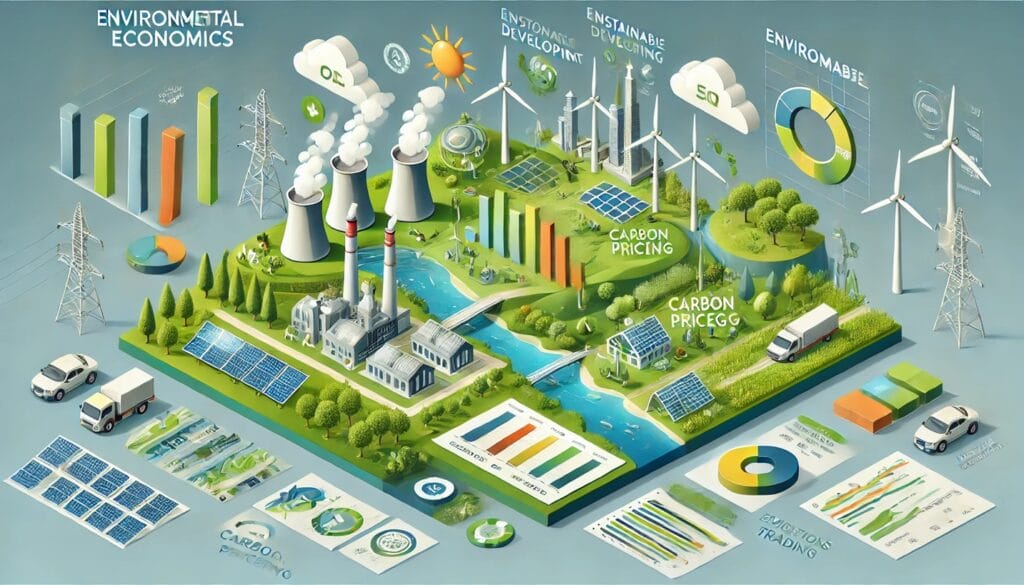
Understanding the world requires understanding incentives — and this course delivers that clarity with force. Designed for students who want more than abstract theory, it dives directly into the economic logic shaping environmental policy, natural resources, energy markets, and sustainability. Every lecture reveals how incentives drive behavior, how markets succeed or fail, and how smart policy can transform outcomes for society and the planet.
You’ll explore the economics behind water scarcity, pollution, fisheries collapse, forestry management, fossil fuels, renewable energy, recycling, and global externalities. These aren’t textbook hypotheticals — they’re the real mechanisms behind climate change, resource depletion, agricultural policy, energy security, and the environmental challenges dominating headlines today. Through case studies ranging from the Nile River to OPEC, from nitrogen runoff to carbon markets, you’ll learn how economic principles explain both the problems and the solutions.
The course emphasizes cost‑effectiveness, dynamic efficiency, scarcity rents, externalities, property rights, and market failures. You’ll see why some policies succeed, why others fail, and how to design interventions that actually work. You’ll learn how markets respond to taxes, quotas, subsidies, standards, and trading systems — and how these tools can align private incentives with social well‑being.
Active learning is built into the experience. You’ll analyze real data, debate policy choices, and apply economic reasoning to complex environmental systems. You won’t just memorize diagrams — you’ll understand how to think like an economist when facing real‑world tradeoffs.
This course is ideal for students interested in environmental science, public policy, economics, sustainability, or global development. It’s also perfect for anyone who wants to understand how the world actually works — how governments make decisions, how industries respond, and how society can navigate the tension between economic growth and environmental protection.
If you want a course that is intellectually rigorous, grounded in reality, and directly relevant to the biggest challenges of our time, this is it. You’ll leave with a powerful analytical toolkit — and a deeper understanding of how incentives shape the future of our planet.
Course Staff
Chief Educational Troublemaker
Michael Williams
Michael Williams is the Chief Educational Troublemaker at World Mentoring Academy — a title he earned the hard way: by spending more than a decade poking, prodding, and occasionally drop‑kicking the traditional education system into the future. In 2010, long before “MOOC” became a Silicon Valley buzzword, Michael was building a free global college from a backpack, a stubborn belief in open learning, and whatever Starbucks Wi‑Fi he could borrow. The Orange County Register profiled him as a “homeless by choice educator to the world,” documenting his 12‑hour days assembling university‑level courses from MIT, Yale, NPTEL, and Stanford — all without charging a cent.
While the big platforms eventually traded “open” for “subscription,” Michael never budged. World Mentoring Academy remains one of the last true free MOOCs on Earth, offering more than 1,000 courses without paywalls, upsells, or fine print.
Michael’s LinkedIn essays — including “Harvard & MIT, Follow a Homeless Educator,” “The Future Won’t Wait for Academia,” and “Future of Education May Have Ancient Roots?” — have earned him a reputation as a futurist with calluses, someone who can explain why AI is breaking the job market, why teens are the workforce pipeline no one is using, and why the next education revolution will look more like ancient Athens than a modern lecture hall.
Across every WMA course, Michael appears as your unofficial guide, mentor, instigator, and occasionally your friendly academic arsonist — the guy who hands you the map, the compass, and the confidence to build a future that doesn’t depend on debt, gatekeeping, or waiting for institutions to catch up.
He helps learners find their place in a world that’s changing faster than universities can update their syllabi — and he does it with humor, humanity, and a refusal to accept that opportunity should be rationed.
If education needs a troublemaker, Michael is happy to volunteer.