About This Course
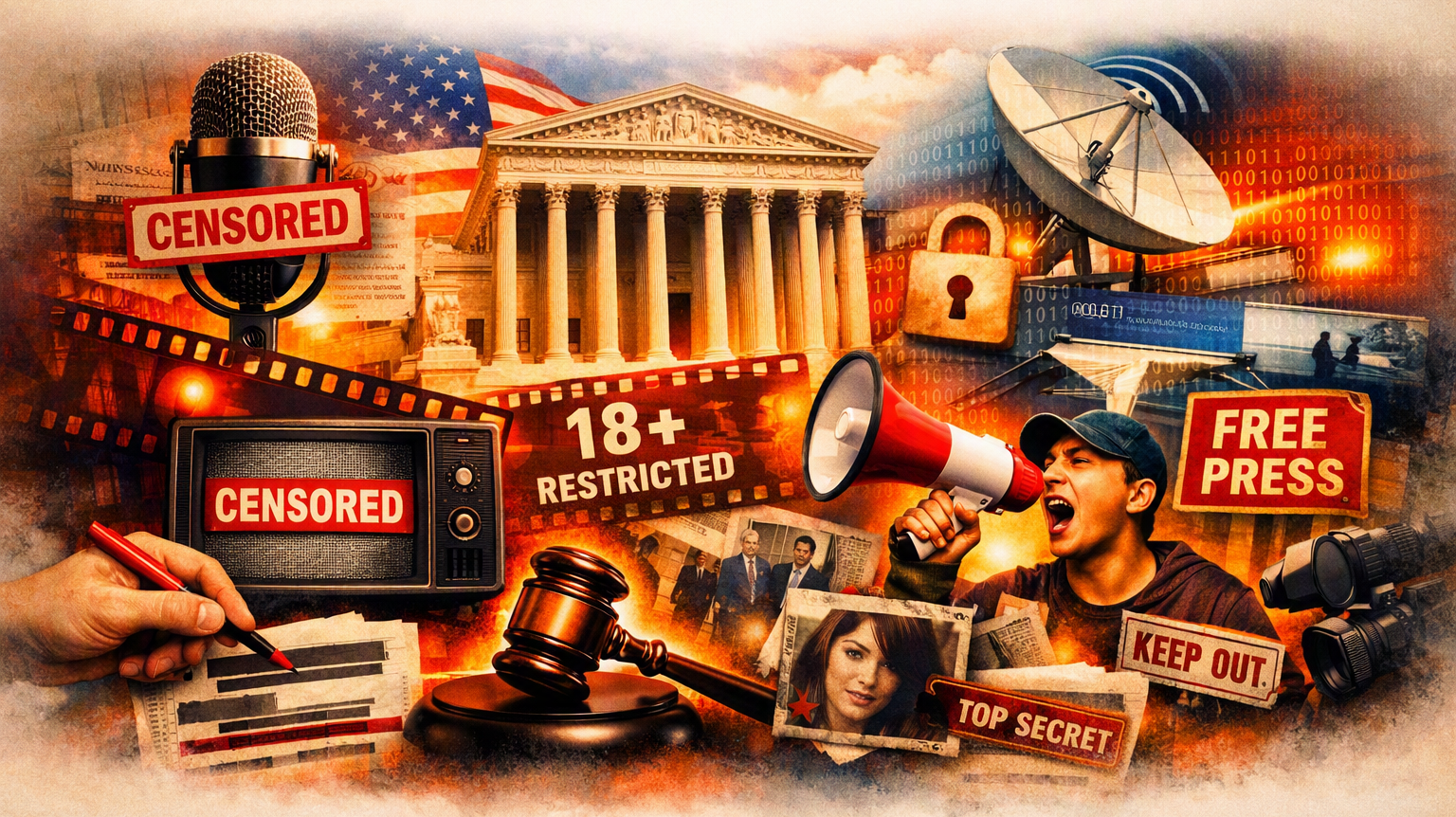
This course is a deep dive into the most dramatic, controversial, and culturally defining battles over free expression in America. If you’ve ever wondered why the press can publish leaked secrets, how the government tries (and often fails) to regulate indecency or violence, or what actually counts as protected speech in the digital age, this class turns those questions into a fast‑moving, eye‑opening journey through real Supreme Court showdowns.
You’ll explore the First Amendment not as a dry constitutional rule, but as a living battleground where artists, journalists, activists, corporations, and everyday citizens fight over what can be said, shown, published, or broadcast. Each week centers on gripping cases—political lies, violent video games, child‑protection laws, parody and satire, press access to prisons and executions, and the explosive clash between privacy and the public’s right to know.
You’ll meet unforgettable characters: Hustler Magazine mocking a national religious leader, a man jailed for lying about receiving the Medal of Honor, broadcasters punished for fleeting expletives, and NGOs forced to adopt government‑approved viewpoints to receive funding. These aren’t abstract hypotheticals—they’re real stories that shaped the rules governing your speech today.
The course also tackles modern challenges: Can Congress censor the internet to protect minors? Should violent media be regulated like obscenity? Does the press deserve special constitutional status? And how do courts handle new technologies—digital imagery, online platforms, cable networks, and global communication that ignores community boundaries?
You’ll learn how courts balance competing values: privacy vs. transparency, safety vs. liberty, morality vs. artistic expression, and government authority vs. individual autonomy. Along the way, you’ll sharpen your ability to read cases, analyze constitutional reasoning, and understand how legal rules evolve as society changes.
This class is perfect for students interested in law, journalism, politics, media, technology, or anyone who wants to understand the freedoms—and limits—that shape public life. Expect lively discussions, surprising case outcomes, and a new appreciation for how fragile and fiercely contested free speech really is.
By the end, you won’t just know the First Amendment—you’ll see it everywhere.
Chief Educational Troublemaker
Michael Williams
Michael Williams is the Chief Educational Troublemaker at World Mentoring Academy — a title he earned the hard way: by spending more than a decade poking, prodding, and occasionally drop‑kicking the traditional education system into the future. In 2010, long before “MOOC” became a Silicon Valley buzzword, Michael was building a free global college from a backpack, a stubborn belief in open learning, and whatever Starbucks Wi‑Fi he could borrow. The Orange County Register profiled him as a “homeless by choice educator to the world,” documenting his 12‑hour days assembling university‑level courses from MIT, Yale, NPTEL, and Stanford — all without charging a cent.
While the big platforms eventually traded “open” for “subscription,” Michael never budged. World Mentoring Academy remains one of the last true free MOOCs on Earth, offering more than 1,000 courses without paywalls, upsells, or fine print.
Michael’s LinkedIn essays — including “Harvard & MIT, Follow a Homeless Educator,” “The Future Won’t Wait for Academia,” and “Future of Education May Have Ancient Roots?” — have earned him a reputation as a futurist with calluses, someone who can explain why AI is breaking the job market, why teens are the workforce pipeline no one is using, and why the next education revolution will look more like ancient Athens than a modern lecture hall.
Across every WMA course, Michael appears as your unofficial guide, mentor, instigator, and occasionally your friendly academic arsonist — the guy who hands you the map, the compass, and the confidence to build a future that doesn’t depend on debt, gatekeeping, or waiting for institutions to catch up.
He helps learners find their place in a world that’s changing faster than universities can update their syllabi — and he does it with humor, humanity, and a refusal to accept that opportunity should be rationed.
If education needs a troublemaker, Michael is happy to volunteer.