About This Course
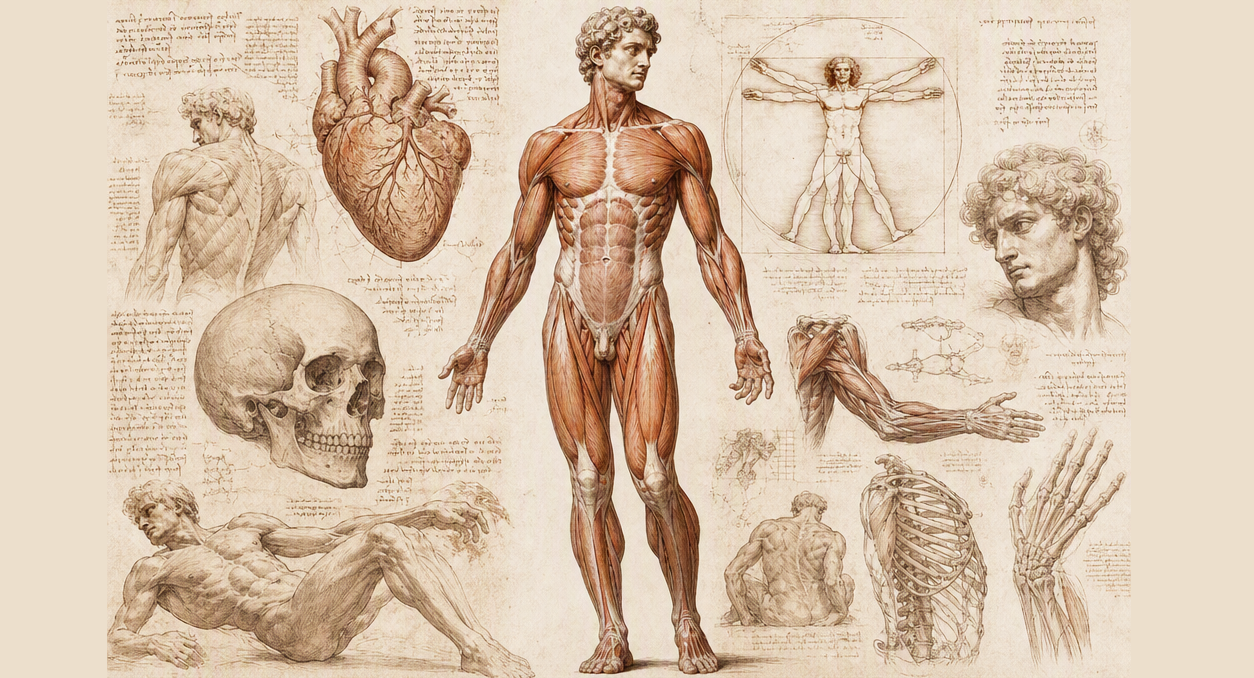
Understanding human anatomy isn’t just for future doctors—it’s a transformational skill that reshapes how you see yourself, your health, and the world around you. When you study the human body, you gain access to the most advanced machine ever created: you. And once you understand how that machine works, you unlock a level of insight, confidence, and capability that stays with you for life.
Anatomy gives you a front‑row seat to the astonishing engineering behind every breath, heartbeat, and movement. You learn how bones bear weight with architectural precision, how muscles coordinate like a symphony, and how organs perform thousands of chemical reactions every second to keep you alive. This knowledge doesn’t just satisfy curiosity—it empowers you. You’ll understand what your doctor is saying, make smarter decisions about exercise and nutrition, and recognize early signs when something isn’t right.
Studying anatomy also sharpens your mind. It trains your memory, strengthens your ability to visualize complex systems, and builds problem‑solving skills that transfer to any profession. Whether you’re pursuing healthcare, fitness, biology, engineering, or simply personal growth, anatomy gives you a foundation of scientific literacy that sets you apart.
There’s also a deeper benefit: studying the human body builds respect. You begin to appreciate the resilience of your tissues, the elegance of your organs, and the fragility of the systems that sustain life. It changes how you treat yourself—and how you treat others. You see humanity not just as faces and personalities, but as intricate biological masterpieces deserving care and compassion.
Finally, anatomy is empowering because it is universal. Every person, regardless of background or career, lives inside a body. Understanding that body is one of the most practical, meaningful investments you can make. It’s knowledge that improves your health, enriches your conversations, and deepens your connection to the human experience.
Studying anatomy isn’t just learning facts—it’s learning yourself. It’s gaining mastery over the vessel that carries you through life. And once you understand it, you’ll never look at the world—or your own reflection—the same way again.
Course Staff
Chief Educational Troublemaker
Michael Williams
Michael Williams is the Chief Educational Troublemaker at World Mentoring Academy — a title he earned the hard way: by spending more than a decade poking, prodding, and occasionally drop‑kicking the traditional education system into the future. In 2010, long before “MOOC” became a Silicon Valley buzzword, Michael was building a free global college from a backpack, a stubborn belief in open learning, and whatever Starbucks Wi‑Fi he could borrow. The Orange County Register profiled him as a “homeless by choice educator to the world,” documenting his 12‑hour days assembling university‑level courses from MIT, Yale, NPTEL, and Stanford — all without charging a cent.
While the big platforms eventually traded “open” for “subscription,” Michael never budged. World Mentoring Academy remains one of the last true free MOOCs on Earth, offering more than 1,000 courses without paywalls, upsells, or fine print.
Michael’s LinkedIn essays — including “Harvard & MIT, Follow a Homeless Educator,” “The Future Won’t Wait for Academia,” and “Future of Education May Have Ancient Roots?” — have earned him a reputation as a futurist with calluses, someone who can explain why AI is breaking the job market, why teens are the workforce pipeline no one is using, and why the next education revolution will look more like ancient Athens than a modern lecture hall.
Across every WMA course, Michael appears as your unofficial guide, mentor, instigator, and occasionally your friendly academic arsonist — the guy who hands you the map, the compass, and the confidence to build a future that doesn’t depend on debt, gatekeeping, or waiting for institutions to catch up.
He helps learners find their place in a world that’s changing faster than universities can update their syllabi — and he does it with humor, humanity, and a refusal to accept that opportunity should be rationed.
If education needs a troublemaker, Michael is happy to volunteer.