About This Course
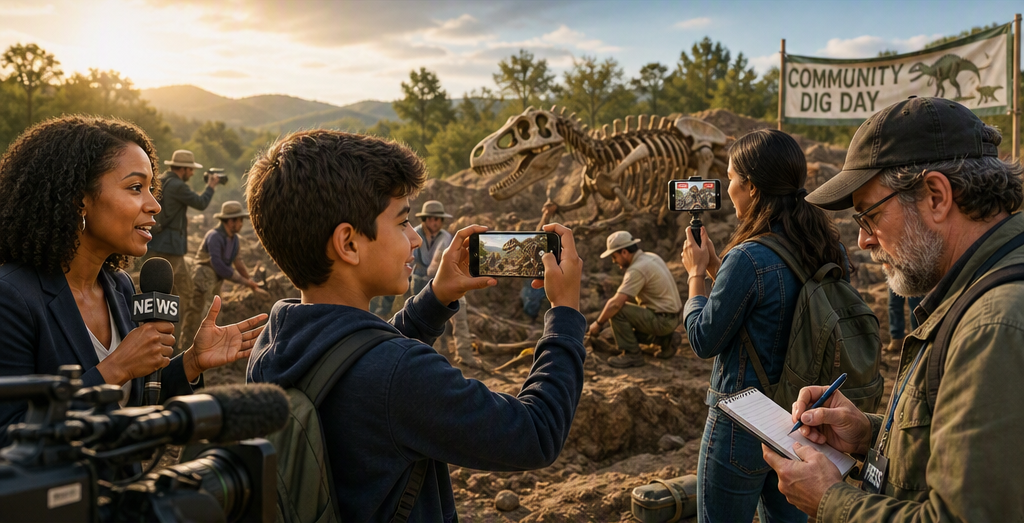
The future of journalism is no longer confined to legacy newsrooms or traditional broadcast towers. We’re entering a new era—one defined by decentralized media, distributed reporting networks, and a public that both consumes and creates information at unprecedented scale. If you care about truth, accountability, and the civic health of your community, this moment is an invitation.
Mainstream journalists: your skills have never been more essential. The rigor you bring—verification, sourcing discipline, ethical judgment, narrative clarity—forms the backbone of trustworthy information. But the platforms and structures around you are changing. Decentralized media allows you to reach audiences directly, build independent authority, and collaborate with emerging voices outside institutional walls. You’re no longer limited by the constraints of a single outlet’s business model. Your credibility becomes portable, your reporting becomes borderless, and your impact becomes global.
Independent and citizen journalists: you are now part of the same ecosystem. The tools once reserved for major newsrooms—publishing platforms, live reporting channels, investigative resources—are accessible to anyone with commitment and curiosity. Decentralized media empowers you to document your community, challenge misinformation, and elevate stories overlooked by traditional gatekeepers. You bring proximity, authenticity, and diversity of perspective that enriches the public record.
But decentralization doesn’t mean abandoning standards. In fact, it demands more of them. The next generation of journalism will be built by people who embrace transparency, verify before amplifying, and understand the ethical weight of public influence. Whether you’re filing a long‑form investigation or livestreaming from your neighborhood, your work contributes to a shared information commons.
This is a call to those who believe journalism is not just a profession, but a public service. A call to people who want to shape a media landscape that is resilient, participatory, and resistant to manipulation. A call to storytellers, analysts, investigators, editors, photographers, coders, and community members who understand that decentralized media is not chaos—it’s opportunity.
If you’re drawn to the future of journalism, step in. The field needs your voice, your discipline, your creativity, and your courage. The next era won’t be built by institutions alone. It will be built by all of us—working together to strengthen the flow of reliable information in a world that depends on it.
Course Staff
Chief Educational Troublemaker
Michael Williams
Michael Williams is the Chief Educational Troublemaker at World Mentoring Academy — a title he earned the hard way: by spending more than a decade poking, prodding, and occasionally drop‑kicking the traditional education system into the future. In 2010, long before “MOOC” became a Silicon Valley buzzword, Michael was building a free global college from a backpack, a stubborn belief in open learning, and whatever Starbucks Wi‑Fi he could borrow. The Orange County Register profiled him as a “homeless by choice educator to the world,” documenting his 12‑hour days assembling university‑level courses from MIT, Yale, NPTEL, and Stanford — all without charging a cent.
While the big platforms eventually traded “open” for “subscription,” Michael never budged. World Mentoring Academy remains one of the last true free MOOCs on Earth, offering more than 1,000 courses without paywalls, upsells, or fine print.
Michael’s LinkedIn essays — including “Harvard & MIT, Follow a Homeless Educator,” “The Future Won’t Wait for Academia,” and “Future of Education May Have Ancient Roots?” — have earned him a reputation as a futurist with calluses, someone who can explain why AI is breaking the job market, why teens are the workforce pipeline no one is using, and why the next education revolution will look more like ancient Athens than a modern lecture hall.
Across every WMA course, Michael appears as your unofficial guide, mentor, instigator, and occasionally your friendly academic arsonist — the guy who hands you the map, the compass, and the confidence to build a future that doesn’t depend on debt, gatekeeping, or waiting for institutions to catch up.
He helps learners find their place in a world that’s changing faster than universities can update their syllabi — and he does it with humor, humanity, and a refusal to accept that opportunity should be rationed.
If education needs a troublemaker, Michael is happy to volunteer.