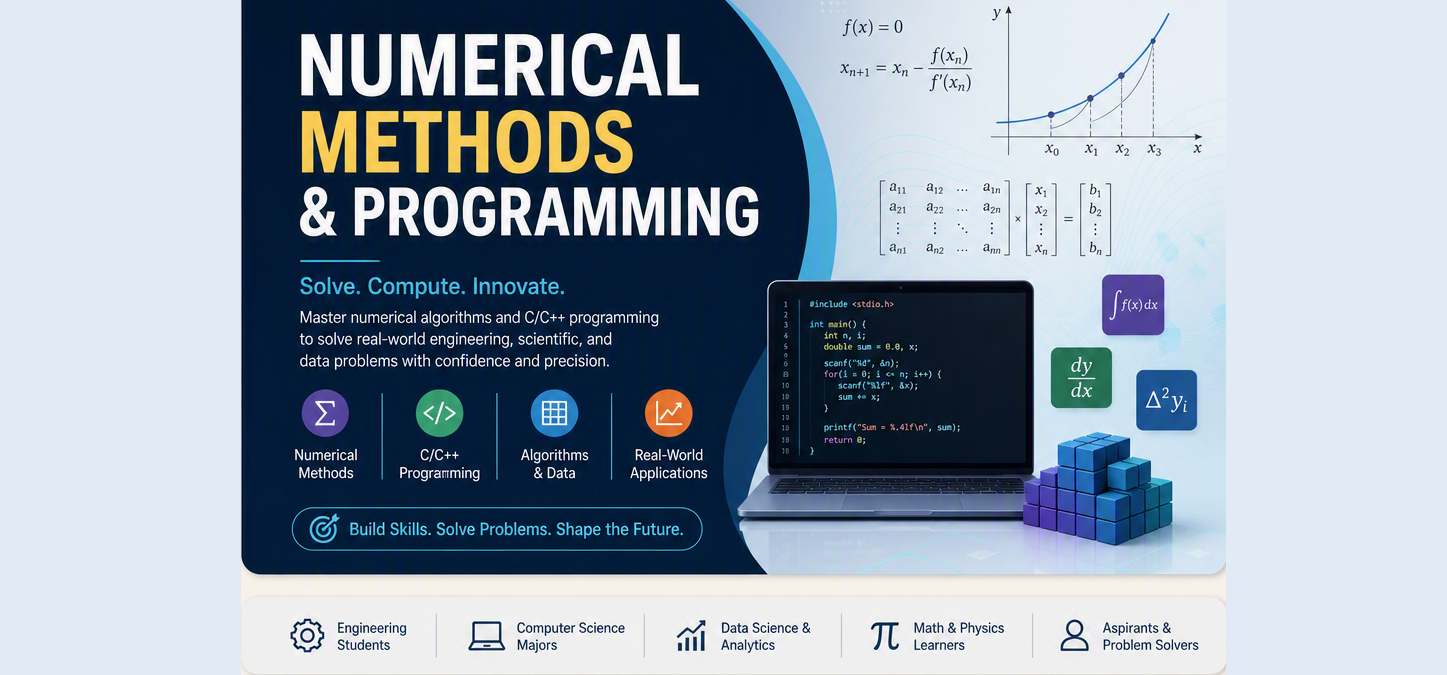
Numerical methods and programing

NPTEL_Madras
Enrollment is Closed

About This Course

Numerical Methods and Programming is the foundational course for anyone seeking a future in engineering, data science, AI, finance, physics, or high‑performance computing. It teaches you how real systems are modeled, how equations are solved when algebra fails, and how computers turn mathematical ideas into working solutions. Whether you dream of designing simulations, optimizing industrial processes, building scientific software, or simply becoming a stronger problem‑solver, this course gives you the tools to get there.

For engineering students, numerical methods are the backbone of structural analysis, fluid dynamics, thermodynamics, and control systems. You’ll learn how to approximate solutions when closed‑form answers don’t exist, using Newton‑Raphson, Gauss‑Seidel, Runge‑Kutta, and other industry‑standard techniques. These are the same methods used in aerospace, automotive, biomedical, and civil engineering applications.

For computer science and programming students, the course offers a deep dive into C and C++ — languages that power operating systems, embedded devices, scientific computing, and high‑performance applications. You’ll dissect programs line‑by‑line, master variables, loops, functions, pointers, arrays, structures, and file I/O. More importantly, you’ll learn programming techniques: how to think algorithmically, how to write efficient code, and how to translate mathematical logic into working software.

For data science and analytics students, numerical methods unlock regression, curve fitting, interpolation, and numerical integration — essential tools for modeling trends, analyzing data, and building predictive systems. You’ll understand how algorithms behave under rounding and truncation errors, as well as floating‑point limitations, giving you a stronger foundation than most analysts ever receive.

For math and physics students, this course bridges theory and computation. You’ll see how Taylor series, differential equations, and matrix operations become numerical algorithms that solve real‑world problems. You’ll learn how Euler, Modified Euler, and Predictor‑Corrector methods approximate dynamic systems, and how difference relations help solve partial differential equations.

For ambitious beginners, this course is the perfect entry point. You don’t need prior programming experience — just curiosity and determination. You’ll build programs from scratch, run simulations, solve equations, and develop confidence in both math and coding.

By the end, you’ll not only understand numerical methods — you’ll be able to implement them, test them, and apply them to real problems. This course gives you practical skills, computational power, and a mindset that opens doors across STEM fields.

Requirements

Add information about the skills and knowledge students need to take this course.

Course Staff


Chief Educational Troublemaker

Michael Williams

Michael Williams is the Chief Educational Troublemaker at World Mentoring Academy — a title he earned the hard way: by spending more than a decade poking, prodding, and occasionally drop‑kicking the traditional education system into the future. In 2010, long before “MOOC” became a Silicon Valley buzzword, Michael was building a free global college from a backpack, a stubborn belief in open learning, and whatever Starbucks Wi‑Fi he could borrow. The Orange County Register profiled him as a “homeless by choice educator to the world,” documenting his 12‑hour days assembling university‑level courses from MIT, Yale, NPTEL, and Stanford — all without charging a cent.
While the big platforms eventually traded “open” for “subscription,” Michael never budged. World Mentoring Academy remains one of the last true free MOOCs on Earth, offering more than 1,000 courses without paywalls, upsells, or fine print.
Michael’s LinkedIn essays — including “Harvard & MIT, Follow a Homeless Educator,” “The Future Won’t Wait for Academia,” and “Future of Education May Have Ancient Roots?” — have earned him a reputation as a futurist with calluses, someone who can explain why AI is breaking the job market, why teens are the workforce pipeline no one is using, and why the next education revolution will look more like ancient Athens than a modern lecture hall.
Across every WMA course, Michael appears as your unofficial guide, mentor, instigator, and occasionally your friendly academic arsonist — the guy who hands you the map, the compass, and the confidence to build a future that doesn’t depend on debt, gatekeeping, or waiting for institutions to catch up.
He helps learners find their place in a world that’s changing faster than universities can update their syllabi — and he does it with humor, humanity, and a refusal to accept that opportunity should be rationed.
If education needs a troublemaker, Michael is happy to volunteer.

Frequently Asked Questions

What web browser should I use?

The Open edX platform works best with current versions of Chrome, Edge, Firefox, or Safari.

See our list of supported browsers for the most up-to-date information.

Question #2

Your answer would be displayed here.

Course Summary

  1. Course Number

    Numerical_methods_and_programing
  2. Classes Start

  3. Classes End