About This Course
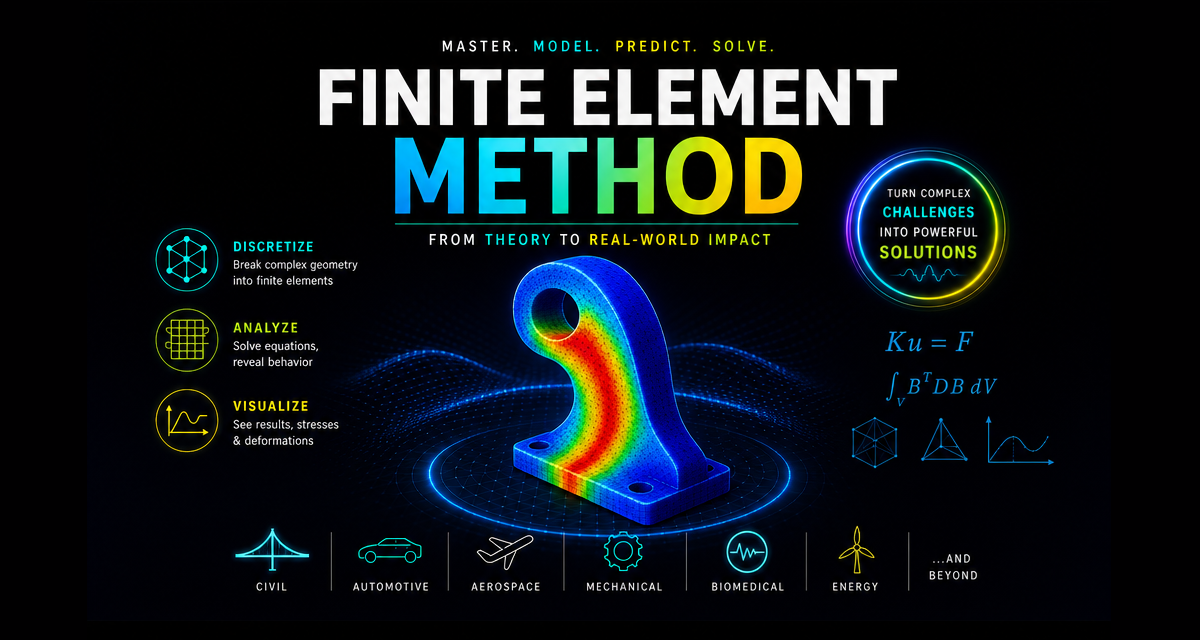
The Finite Element Method (FEM) is the backbone of modern engineering simulation, powering everything from structural analysis and mechanical design to aerospace systems, automotive engineering, biomechanics, and advanced materials research. This course gives you a complete, intuitive, and application‑driven understanding of FEM, guiding you from the mathematical foundations to real‑world problem solving using industry‑standard techniques.
You begin by learning the essential principles behind FEM: discretization, element formulation, interpolation functions, stiffness matrices, boundary conditions, and numerical solution strategies. Each concept is broken down into clear, accessible explanations that help you understand not just how FEM works, but why it works. You’ll explore 1D, 2D, and 3D elements; linear and nonlinear systems; static and dynamic analysis; and the role of material models in predicting real‑world behavior.
As you progress, you’ll apply FEM to practical engineering problems—beam bending, heat transfer, stress analysis, vibration modes, and multi‑physics scenarios. You’ll see how engineers use FEM to evaluate safety, optimize designs, reduce costs, and accelerate innovation across industries. Case studies from aerospace, civil engineering, automotive design, and robotics show how FEM transforms complex physical systems into solvable numerical models.
The course includes a rich set of learning resources: conceptual diagrams, worked examples, step‑by‑step derivations, problem sets, and optional software demonstrations. Whether you’re using open‑source tools or commercial solvers, you’ll gain the confidence to set up models, interpret results, and avoid common pitfalls in simulation.
But what truly elevates this course is the community of learners you join. You’ll be part of a network of engineering students, professionals, researchers, and self‑improvers who share your drive to master advanced analytical tools. Through discussions, collaborative problem‑solving, and shared insights, you’ll deepen your understanding and accelerate your progress. This is a space where curiosity meets capability—where beginners gain clarity, intermediates gain confidence, and advanced learners refine their expertise.
Whether you’re preparing for engineering coursework, strengthening your professional skill set, or exploring simulation as a pathway to innovation, this course gives you the foundation and momentum to succeed. Master the Finite Element Method and unlock the analytical power that drives modern engineering forward.
This is paragraph 2 of the long course description. Add more paragraphs as needed. Make sure to enclose them in paragraph tags.
Course Staff
Chief Educational Troublemaker
Michael Williams
Michael Williams is the Chief Educational Troublemaker at World Mentoring Academy — a title he earned the hard way: by spending more than a decade poking, prodding, and occasionally drop‑kicking the traditional education system into the future. In 2010, long before “MOOC” became a Silicon Valley buzzword, Michael was building a free global college from a backpack, a stubborn belief in open learning, and whatever Starbucks Wi‑Fi he could borrow. The Orange County Register profiled him as a “homeless-by-choice educator to the world,” documenting his 12‑hour days assembling university‑level courses from MIT, Yale, NPTEL, and Stanford — all without charging a cent.
While the big platforms eventually traded “open” for “subscription,” Michael never budged. World Mentoring Academy remains one of the last true free MOOCs on Earth, offering more than 1,000 courses without paywalls, upsells, or fine print.
Michael’s LinkedIn essays — including “Harvard & MIT, Follow a Homeless Educator,” “The Future Won’t Wait for Academia,” and “Future of Education May Have Ancient Roots?” — have earned him a reputation as a futurist with calluses, someone who can explain why AI is breaking the job market, why teens are the workforce pipeline no one is using, and why the next education revolution will look more like ancient Athens than a modern lecture hall.
Across every WMA course, Michael appears as your unofficial guide, mentor, instigator, and occasionally your friendly academic arsonist — the guy who hands you the map, the compass, and the confidence to build a future that doesn’t depend on debt, gatekeeping, or waiting for institutions to catch up.
He helps learners find their place in a world that’s changing faster than universities can update their syllabi — and he does it with humor, humanity, and a refusal to accept that opportunity should be rationed.
If education needs a troublemaker, Michael is happy to volunteer.