About This Course
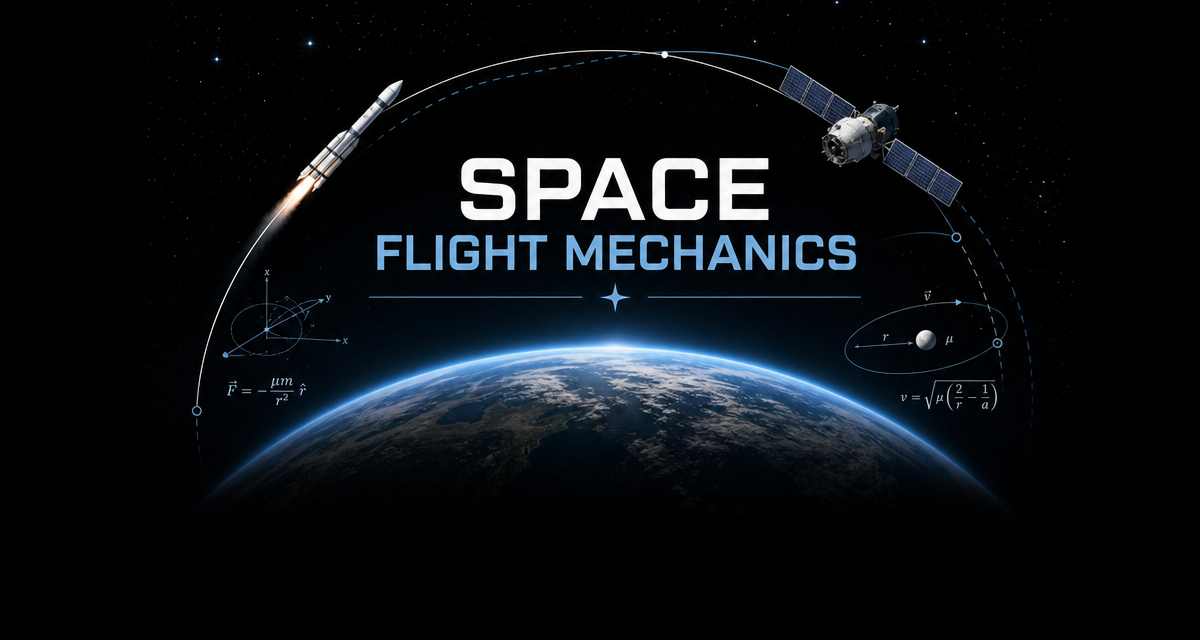
Space Flight Mechanics is the foundation of every successful mission beyond Earth. This course gives you a deep, structured understanding of how spacecraft launch, maneuver, orbit, rendezvous, and travel across the solar system. Designed for curious learners, aspiring aerospace engineers, and self‑improvers who want to master the physics behind space exploration, the course blends theory, real‑world applications, and mission‑proven techniques used by NASA, ESA, and commercial spaceflight companies.
You’ll begin with the fundamentals of Newtonian mechanics, gravitational forces, and two‑body orbital motion, building a clear understanding of how spacecraft behave in space. From there, you’ll explore orbital elements, Kepler’s laws, circular and elliptical orbits, and the mathematics that govern satellite trajectories. Each concept is broken down into simple, intuitive explanations supported by diagrams, examples, and problem‑solving exercises.
As you progress, you’ll dive into the mechanics of launch vehicles, escape velocity, transfer orbits, Hohmann transfers, inclination changes, and delta‑v budgeting—the essential tools behind mission planning. You’ll learn how spacecraft perform rendezvous, docking, station‑keeping, and attitude control, and how engineers design missions to the Moon, Mars, and beyond using gravity assists and interplanetary trajectories.
The course includes a rich set of resources: conceptual videos, worked examples, mission case studies, downloadable reference sheets, and optional problem sets that reinforce your understanding. You’ll study real missions—Apollo, Voyager, ISS operations, Mars rovers, Artemis, and commercial launches—to see how theory becomes reality.
But the heart of this course is the community of learners you join. You’ll be part of a group of space enthusiasts, engineering students, hobbyists, and lifelong learners who share your passion for exploration and discovery. Through discussions, study groups, and collaborative problem‑solving, you’ll learn from others, share insights, and build confidence as you master increasingly advanced concepts. This is a space where curiosity is celebrated, questions are welcomed, and progress is shared.
Whether you dream of working in aerospace, want to understand the mechanics behind modern space missions, or simply love the science of how we reach the stars, this course gives you the knowledge and momentum to go further. Your journey into the physics of spaceflight begins here.
This is paragraph 2 of the long course description. Add more paragraphs as needed. Make sure to enclose them in paragraph tags.
Course Staff
Chief Educational Troublemaker
Michael Williams
Michael Williams is the Chief Educational Troublemaker at World Mentoring Academy — a title he earned the hard way: by spending more than a decade poking, prodding, and occasionally drop‑kicking the traditional education system into the future. In 2010, long before “MOOC” became a Silicon Valley buzzword, Michael was building a free global college from a backpack, a stubborn belief in open learning, and whatever Starbucks Wi‑Fi he could borrow. The Orange County Register profiled him as a “homeless-by-choice educator to the world,” documenting his 12‑hour days assembling university‑level courses from MIT, Yale, NPTEL, and Stanford — all without charging a cent.
While the big platforms eventually traded “open” for “subscription,” Michael never budged. World Mentoring Academy remains one of the last true free MOOCs on Earth, offering more than 1,000 courses without paywalls, upsells, or fine print.
Michael’s LinkedIn essays — including “Harvard & MIT, Follow a Homeless Educator,” “The Future Won’t Wait for Academia,” and “Future of Education May Have Ancient Roots?” — have earned him a reputation as a futurist with calluses, someone who can explain why AI is breaking the job market, why teens are the workforce pipeline no one is using, and why the next education revolution will look more like ancient Athens than a modern lecture hall.
Across every WMA course, Michael appears as your unofficial guide, mentor, instigator, and occasionally your friendly academic arsonist — the guy who hands you the map, the compass, and the confidence to build a future that doesn’t depend on debt, gatekeeping, or waiting for institutions to catch up.
He helps learners find their place in a world that’s changing faster than universities can update their syllabi — and he does it with humor, humanity, and a refusal to accept that opportunity should be rationed.
If education needs a troublemaker, Michael is happy to volunteer.