About This Course
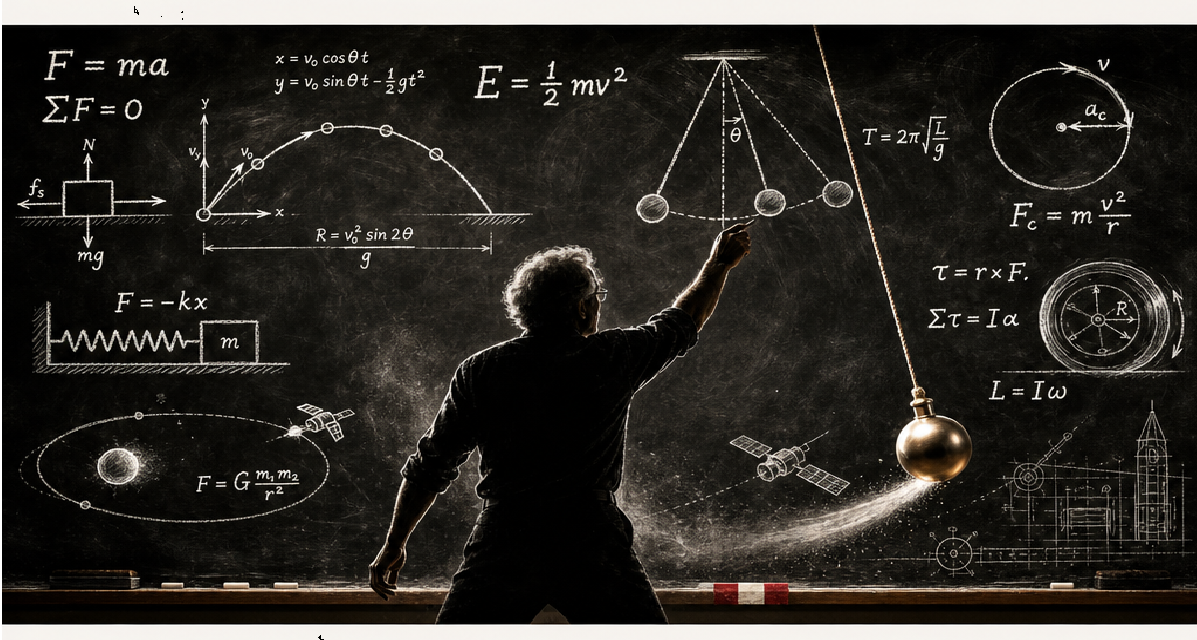
MIT Physics I: Classical Mechanics is one of the most iconic science courses ever recorded, taught by the legendary Professor Walter Lewin, whose electrifying demonstrations and unmistakable teaching style turned generations of students into lifelong physics believers. This course offers a complete, open‑access learning experience: full lecture notes, problem sets with solutions, exams with solutions, and a complete 35‑lecture video series recorded live at MIT in Fall 1999. Lewin’s dynamic approach—swinging from pendulums, firing projectiles across the lecture hall, and turning abstract equations into vivid, unforgettable experiences—makes classical mechanics come alive in a way few instructors ever achieve.
The course covers the foundational principles that govern motion in our universe: kinematics, Newton’s laws, conservation of energy and momentum, rotational dynamics, harmonic motion, gravitation, and the mathematical tools that support them. Students learn not only how to solve physics problems, but how to think like physicists—translating real‑world phenomena into models, equations, and predictions. Lewin’s emphasis on intuition, visualization, and physical reasoning helps learners build a deep conceptual understanding that lasts far beyond the final exam.
Problem sets and exams, all with full solutions, reinforce each concept and provide structured practice for mastering the material. Learners can follow the original MIT sequence, working through weekly assignments and testing their understanding with authentic MIT assessments. The course also includes links to related resources, enabling motivated students to explore deeper topics or connect classical mechanics to modern physics, engineering, and applied sciences.
What sets this course apart is Lewin himself. His lectures are performances—carefully crafted demonstrations, precise explanations, and moments of genuine wonder. Whether he’s dropping weights from the ceiling, riding a rolling cart to illustrate momentum, or using lasers and springs to reveal hidden symmetries, Lewin transforms classical mechanics into a living subject. His passion is contagious, and his clarity makes even the most challenging ideas accessible.
By the end of the course, students will have a strong foundation in classical mechanics, confidence in problem‑solving, and a renewed appreciation for the beauty of physics. This is more than a class—it’s a master teacher at the height of his powers, offering one of the most engaging introductions to physics ever created.
Course Staff
Chief Educational Troublemaker
Michael Williams
Michael Williams is the Chief Educational Troublemaker at World Mentoring Academy — a title he earned the hard way: by spending more than a decade poking, prodding, and occasionally drop‑kicking the traditional education system into the future. In 2010, long before “MOOC” became a Silicon Valley buzzword, Michael was building a free global college from a backpack, a stubborn belief in open learning, and whatever Starbucks Wi‑Fi he could borrow. The Orange County Register profiled him as a “homeless-by-choice educator to the world,” documenting his 12‑hour days assembling university‑level courses from MIT, Yale, NPTEL, and Stanford — all without charging a cent.
While the big platforms eventually traded “open” for “subscription,” Michael never budged. World Mentoring Academy remains one of the last true free MOOCs on Earth, offering more than 1,000 courses without paywalls, upsells, or fine print.
Michael’s LinkedIn essays — including “Harvard & MIT, Follow a Homeless Educator,” “The Future Won’t Wait for Academia,” and “Future of Education May Have Ancient Roots?” — have earned him a reputation as a futurist with calluses, someone who can explain why AI is breaking the job market, why teens are the workforce pipeline no one is using, and why the next education revolution will look more like ancient Athens than a modern lecture hall.
Across every WMA course, Michael appears as your unofficial guide, mentor, instigator, and occasionally your friendly academic arsonist — the guy who hands you the map, the compass, and the confidence to build a future that doesn’t depend on debt, gatekeeping, or waiting for institutions to catch up.
He helps learners find their place in a world that’s changing faster than universities can update their syllabi — and he does it with humor, humanity, and a refusal to accept that opportunity should be rationed.
If education needs a troublemaker, Michael is happy to volunteer.