About This Course
For many people, the word calculus brings a familiar knot to the stomach—memories of rushed classes, confusing symbols, or feeling like everyone else “got it” except you. MATH‑150x: Highlights of Calculus is designed to undo that story. This course creates a calm, encouraging space where learners can finally understand what calculus is really about: simple ideas that explain how things change, grow, move, and connect.
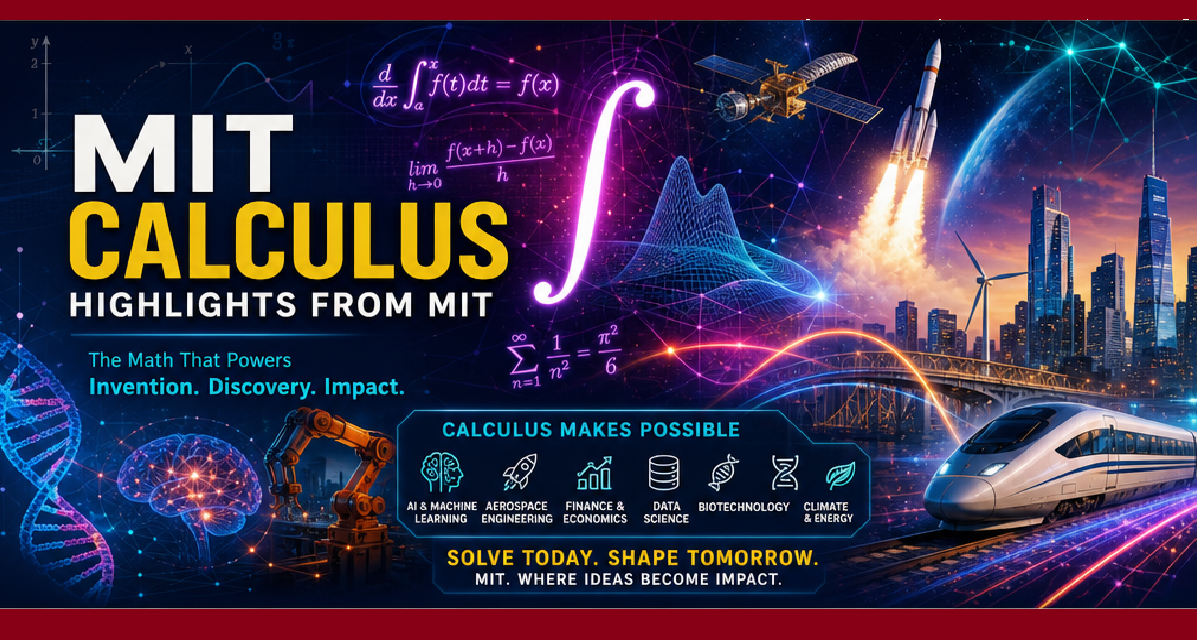
Instead of overwhelming you with formulas, this course starts with the big picture—why calculus matters and how it shows up in real life. You’ll see how it powers everything from medical imaging to climate science, from architecture to AI, from engineering to economics. Calculus isn’t a wall; it’s a doorway into understanding the world more clearly.
One of the greatest strengths of this course is its gentle pacing. Inspired by the widely praised MIT “Highlights of Calculus” series, each lesson is short, friendly, and focused on a single idea. Students and educators across the internet consistently describe Professor Gilbert Strang’s teaching as “comforting,” “clear,” and “surprisingly fun.” His narration guides you through summary slides and practice problems in a way that feels like someone is walking beside you, not lecturing from above.
This course is built for people who have felt left behind by math classes. You’ll find:
-
No pressure—learn at your own pace, repeat lessons as needed, and celebrate small wins.
-
No judgment—every question is valid, every confusion is normal.
-
No gatekeeping—you don’t need to be “good at math” to understand calculus; you just need a patient guide.
We focus on intuition first: what a derivative means, why a curve’s slope matters, and how areas under curves tell stories about motion and accumulation. Once the ideas click, the symbols make sense. And if they don’t right away, you’re in the right place—this course is designed for exactly that.
By the end, you won’t just know more math—you’ll feel differently about it. You’ll see that calculus isn’t a test of intelligence; it’s a tool for thinking, a language for describing change, and a skill that opens doors to careers in science, technology, design, health, and innovation.
MATH‑150x: Highlights of Calculus is your chance to rewrite your relationship with math in a supportive, low‑stress environment where understanding—not speed—is the goal.
Course Staff
Lecturer
Prof Gilbert Strang
Professor Gilbert Strang is a renowned mathematician and one of MIT’s most celebrated educators. A longtime member of the MIT Department of Mathematics, Strang has shaped how millions of learners understand calculus, linear algebra, and applied mathematics through his clear, intuitive teaching style.
Strang earned his undergraduate degree at MIT, studied as a Rhodes Scholar at Oxford, and completed his PhD at UCLA. He has served as President of the Society for Industrial and Applied Mathematics (SIAM) and is a member of the National Academy of Engineering.
He is best known worldwide for his influential MIT OpenCourseWare lectures — especially Linear Algebra and Highlights of Calculus — which have become some of the most-watched university math courses in history. His OCW videos, textbooks, and teaching materials are praised for making advanced mathematics accessible, welcoming, and conceptually clear.
Professor Strang’s work continues to define the gold standard for open, high‑quality mathematics education, inspiring students, educators, and independent learners across the globe.
Chief Educational Troublemaker
Michael Williams
Michael Williams is the Chief Educational Troublemaker at World Mentoring Academy — a title he earned the hard way: by spending more than a decade poking, prodding, and occasionally drop‑kicking the traditional education system into the future. In 2010, long before “MOOC” became a Silicon Valley buzzword, Michael was building a free global college from a backpack, a stubborn belief in open learning, and whatever Starbucks Wi‑Fi he could borrow. The Orange County Register profiled him as a “homeless-by-choice educator to the world,” documenting his 12‑hour days assembling university‑level courses from MIT, Yale, NPTEL, and Stanford — all without charging a cent.
While the big platforms eventually traded “open” for “subscription,” Michael never budged. World Mentoring Academy remains one of the last true free MOOCs on Earth, offering more than 1,000 courses without paywalls, upsells, or fine print.
Michael’s LinkedIn essays — including “Harvard & MIT, Follow a Homeless Educator,” “The Future Won’t Wait for Academia,” and “Future of Education May Have Ancient Roots?” — have earned him a reputation as a futurist with calluses, someone who can explain why AI is breaking the job market, why teens are the workforce pipeline no one is using, and why the next education revolution will look more like ancient Athens than a modern lecture hall.
Across every WMA course, Michael appears as your unofficial guide, mentor, instigator, and occasionally your friendly academic arsonist — the guy who hands you the map, the compass, and the confidence to build a future that doesn’t depend on debt, gatekeeping, or waiting for institutions to catch up.
He helps learners find their place in a world that’s changing faster than universities can update their syllabi — and he does it with humor, humanity, and a refusal to accept that opportunity should be rationed.
If education needs a troublemaker, Michael is happy to volunteer.