American Government

Hillsdale_College

About This Course

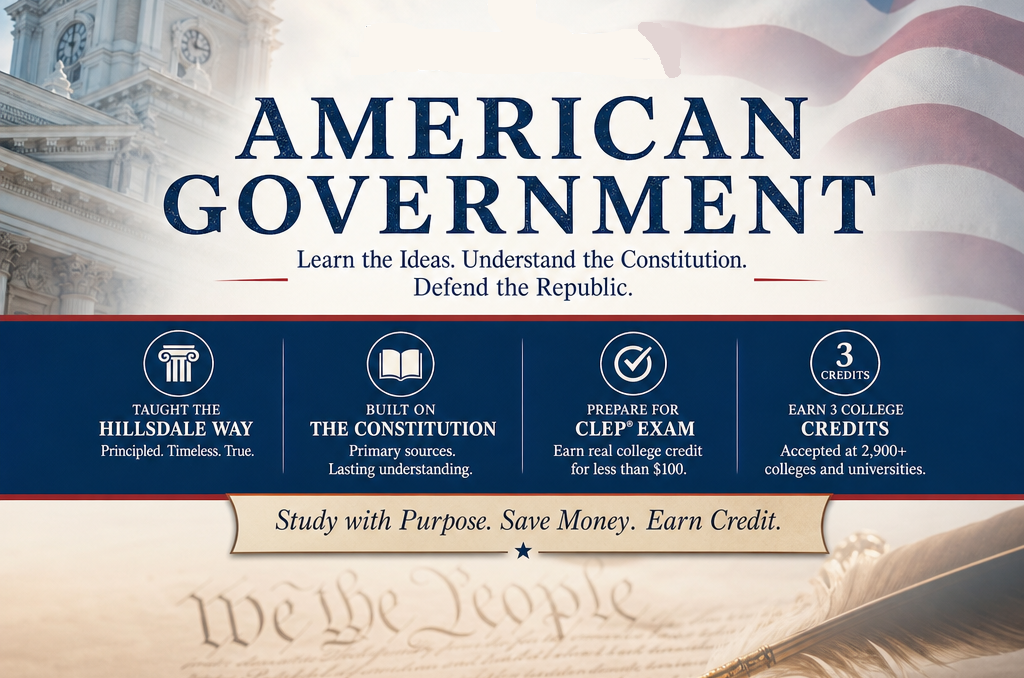
American Government at Hillsdale College isn’t just another class—it’s a fast‑paced, idea‑packed journey into the heart of how the United States actually works. Instead of slogging through dry facts, you get to explore the Constitution, the Founding, and the big debates that shaped the nation like you’re stepping right into the story. It feels less like homework and more like uncovering the blueprint of a country built on bold ideas and even bolder people.

You’ll dig into the Constitution as if it’s a living puzzle—why each branch exists, how power is balanced, and what the Founders were trying to prevent (and encourage). You’ll debate real Supreme Court cases, explore the evolution of political parties, and trace how American institutions grew, clashed, and adapted over time. Every class feels like a mix of detective work, spirited discussion, and “aha” moments.

And here’s the best part: all this learning doesn’t just stay in the classroom. You’ll start spotting constitutional principles in everyday news, political conversations, and even the way local communities make decisions. It’s empowering to understand not just what the government does, but why it does it—and how citizens play a role in keeping the republic healthy.

The course is lively, interactive, and full of energy. Discussions get animated, ideas bounce around the room, and you walk out feeling sharper, more informed, and more connected to the country’s story. Hillsdale’s emphasis on original documents means you’re reading the real words of the people who shaped America—not watered‑down summaries—so you get the full flavor of the debates that built the nation.

And if you’re looking to earn college credit, this class sets you up beautifully. By mastering the core principles of American government, you’ll be well‑prepared to take the CLEP or AP U.S. Government exam, giving you the chance to earn 3 college credits while having fun learning the material. It’s a smart, efficient way to get ahead academically while diving into one of the most fascinating subjects out there.

By the end, you won’t just understand American government—you’ll appreciate it, question it, and feel confident navigating it. It’s challenging, inspiring, and surprisingly fun.

Requirements

Add information about the skills and knowledge students need to take this course.

Course Staff

Course Staff

Michael Williams

Educational Troublemaker

Michael Williams is the Chief Educational Troublemaker at World Mentoring Academy — a title he earned the hard way: by spending more than a decade poking, prodding, and occasionally drop‑kicking the traditional education system into the future. In 2010, long before “MOOC” became a Silicon Valley buzzword, Michael was building a free global college from a backpack, a stubborn belief in open learning, and whatever Starbucks Wi‑Fi he could borrow. The Orange County Register profiled him as a “homeless by choice educator to the world,” documenting his 12‑hour days assembling university‑level courses from MIT, Yale, NPTEL, and Stanford — all without charging a cent.
While the big platforms eventually traded “open” for “subscription,” Michael never budged. World Mentoring Academy remains one of the last true free MOOCs on Earth, offering more than 1,000 courses without paywalls, upsells, or fine print.
Michael’s LinkedIn essays — including “Harvard & MIT, Follow a Homeless Educator,” “The Future Won’t Wait for Academia,” and “Future of Education May Have Ancient Roots?” — have earned him a reputation as a futurist with calluses, someone who can explain why AI is breaking the job market, why teens are the workforce pipeline no one is using, and why the next education revolution will look more like ancient Athens than a modern lecture hall.
Across every WMA course, Michael appears as your unofficial guide, mentor, instigator, and occasionally your friendly academic arsonist — the guy who hands you the map, the compass, and the confidence to build a future that doesn’t depend on debt, gatekeeping, or waiting for institutions to catch up.
He helps learners find their place in a world that’s changing faster than universities can update their syllabi — and he does it with humor, humanity, and a refusal to accept that opportunity should be rationed.
If education needs a troublemaker, Michael is happy to volunteer.

Frequently Asked Questions

What web browser should I use?

The Open edX platform works best with current versions of Chrome, Edge, Firefox, or Safari.

See our list of supported browsers for the most up-to-date information.

Question #2

Your answer would be displayed here.

Enroll