About This Course
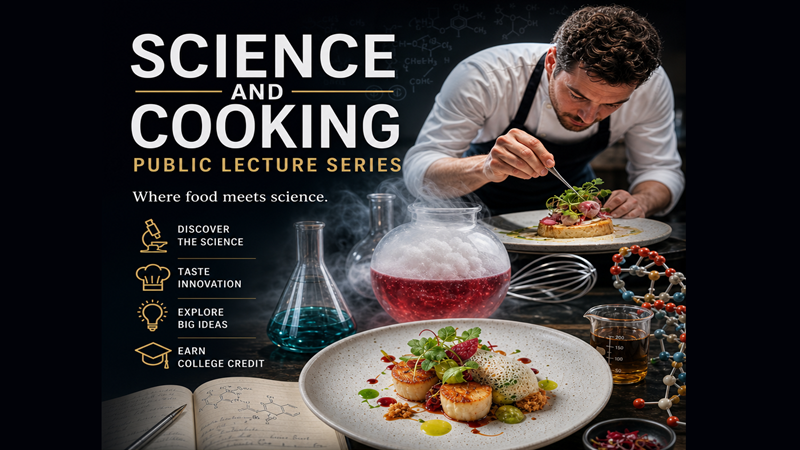
Harvard University’s Science and Cooking Public Lecture Series is where the world’s most creative chefs and leading scientists meet at the crossroads of flavor and physics. Each lecture transforms the kitchen into a laboratory, revealing how heat, chemistry, and molecular structure shape the textures and tastes we love. From the perfect sear to the silky smoothness of chocolate, this series celebrates the art of cooking through the lens of scientific discovery.
Imagine learning why emulsions make sauces creamy, how sugar crystallization defines candy, and how pressure and temperature unlock new dimensions of flavor. The series features culinary innovators from around the globe — Michelin‑starred chefs, pastry masters, and food technologists — who demonstrate techniques that merge tradition with cutting‑edge science. You’ll see how chefs use liquid nitrogen to create ethereal desserts, how fermentation transforms flavor profiles, and how physics explains the crunch of a perfect crust.
But this isn’t just about watching food being made — it’s about understanding why it works. Harvard’s scientists break down the molecular reactions behind cooking, connecting everyday ingredients to universal scientific principles. You’ll leave with a deeper appreciation for the chemistry of caramelization, the physics of foam, and the biology of taste perception.
For food lovers, innovators, and lifelong learners, this series offers more than inspiration — it’s a gateway to academic achievement. Mastering the scientific foundations of cooking can help you earn 3 college units through CLEP Natural Sciences or AP Chemistry, applying your passion for food to real academic credit. Whether you’re a home cook experimenting with sous‑vide, a culinary student exploring molecular gastronomy, or a science enthusiast fascinated by flavor, this course bridges delicious eating with intellectual discovery.
Join Harvard’s Science and Cooking Lecture Series and experience a feast for the senses — where every bite tells a story of chemistry, creativity, and culture. It’s not just cooking; it’s the science of pleasure, innovation, and the future of flavor.
Course Staff
Chief Educational Troublemaker
Michael Williams
Michael Williams is the Chief Educational Troublemaker at World Mentoring Academy — a title he earned the hard way: by spending more than a decade poking, prodding, and occasionally drop‑kicking the traditional education system into the future. In 2010, long before “MOOC” became a Silicon Valley buzzword, Michael was building a free global college from a backpack, a stubborn belief in open learning, and whatever Starbucks Wi‑Fi he could borrow. The Orange County Register profiled him as a “homeless by choice educator to the world,” documenting his 12‑hour days assembling university‑level courses from MIT, Yale, NPTEL, and Stanford — all without charging a cent.
While the big platforms eventually traded “open” for “subscription,” Michael never budged. World Mentoring Academy remains one of the last true free MOOCs on Earth, offering more than 1,000 courses without paywalls, upsells, or fine print.
Michael’s LinkedIn essays — including “Harvard & MIT, Follow a Homeless Educator,” “The Future Won’t Wait for Academia,” and “Future of Education May Have Ancient Roots?” — have earned him a reputation as a futurist with calluses, someone who can explain why AI is breaking the job market, why teens are the workforce pipeline no one is using, and why the next education revolution will look more like ancient Athens than a modern lecture hall.
Across every WMA course, Michael appears as your unofficial guide, mentor, instigator, and occasionally your friendly academic arsonist — the guy who hands you the map, the compass, and the confidence to build a future that doesn’t depend on debt, gatekeeping, or waiting for institutions to catch up.
He helps learners find their place in a world that’s changing faster than universities can update their syllabi — and he does it with humor, humanity, and a refusal to accept that opportunity should be rationed.
If education needs a troublemaker, Michael is happy to volunteer.