About This Course
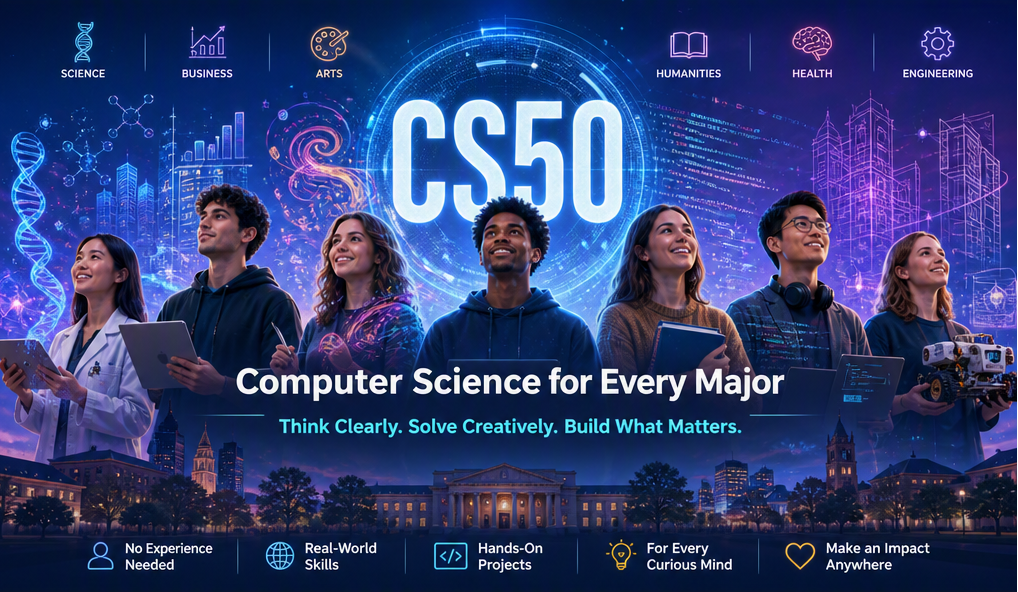
Imagine walking into a class where every student—artists, engineers, economists, musicians, biologists, educators, entrepreneurs—sits shoulder‑to‑shoulder, not because they all want to become programmers, but because they want to understand the world they’re living in. CS50 is that class.
This course isn’t about memorizing syntax or becoming a “computer person.” It’s about learning to think with precision, creativity, and confidence. Whether you’re studying psychology, business, political science, nursing, architecture, or environmental science, CS50 gives you a skill set that quietly powers every modern career: problem‑solving, computational thinking, and the ability to build or automate the tools you wish existed.
If you’re an economics major, CS50 teaches you how data actually moves, how markets are modeled, and how algorithms shape global trade. If you’re in biology or health sciences, you’ll learn how simulations, diagnostics, and research tools are built—and how you can build your own. If you’re studying art, design, or media, CS50 gives you the power to create interactive experiences, digital installations, and generative art. If you’re in business, CS50 demystifies the technology behind every startup pitch, every dashboard, every product roadmap. If you’re in education, CS50 shows you how to build tools that help students learn faster and more equitably. If you’re in social sciences, CS50 gives you the ability to analyze data, visualize trends, and understand the algorithms shaping society. If you’re in the humanities, CS50 gives you a new lens for understanding logic, structure, and the digital systems influencing culture.
And if you’re simply someone who has ever said, “I wish I knew how computers actually work,” CS50 is the most welcoming doorway you’ll ever find.
You’ll start with Scratch—yes, the colorful drag‑and‑drop blocks—and end by building full applications in C, Python, SQL, JavaScript, and Flask. You’ll learn how the internet works, how data is stored, how software is designed, and how real‑world problems are solved with code. You’ll struggle, you’ll laugh, you’ll debug at 2 AM, and you’ll surprise yourself with what you can build.
CS50 isn’t just a class. It’s a transformation. It’s the moment you stop being intimidated by technology and start shaping it.
This is your invitation. Join the story. Join CS50.
Course Staff
Chief Educational Troublemaker
Michael Williams
Michael Williams is the Chief Educational Troublemaker at World Mentoring Academy — a title he earned the hard way: by spending more than a decade poking, prodding, and occasionally drop‑kicking the traditional education system into the future. In 2010, long before “MOOC” became a Silicon Valley buzzword, Michael was building a free global college from a backpack, a stubborn belief in open learning, and whatever Starbucks Wi‑Fi he could borrow. The Orange County Register profiled him as a “homeless by choice educator to the world,” documenting his 12‑hour days assembling university‑level courses from MIT, Yale, NPTEL, and Stanford — all without charging a cent.
While the big platforms eventually traded “open” for “subscription,” Michael never budged. World Mentoring Academy remains one of the last true free MOOCs on Earth, offering more than 1,000 courses without paywalls, upsells, or fine print.
Michael’s LinkedIn essays — including “Harvard & MIT, Follow a Homeless Educator,” “The Future Won’t Wait for Academia,” and “Future of Education May Have Ancient Roots?” — have earned him a reputation as a futurist with calluses, someone who can explain why AI is breaking the job market, why teens are the workforce pipeline no one is using, and why the next education revolution will look more like ancient Athens than a modern lecture hall.
Across every WMA course, Michael appears as your unofficial guide, mentor, instigator, and occasionally your friendly academic arsonist — the guy who hands you the map, the compass, and the confidence to build a future that doesn’t depend on debt, gatekeeping, or waiting for institutions to catch up.
He helps learners find their place in a world that’s changing faster than universities can update their syllabi — and he does it with humor, humanity, and a refusal to accept that opportunity should be rationed.
If education needs a troublemaker, Michael is happy to volunteer.