About This Course
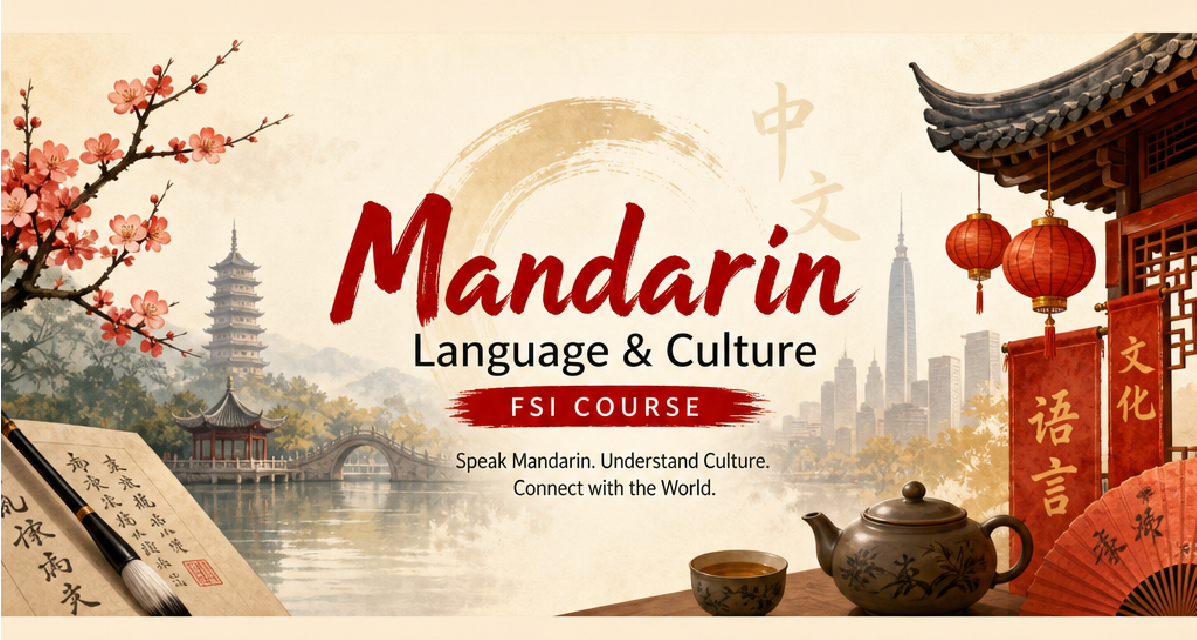
This comprehensive Mandarin Basic‑Level course, developed by the Foreign Service Institute (FSI), has trained U.S. diplomats and government officers for over thirty years in practical, real‑world Chinese communication. Its proven methodology—so influential that programs like Rosetta Stone and Pimsleur draw heavily from it—combines structured repetition, cultural immersion, and functional fluency to help learners speak confidently and connect meaningfully.
The program includes 120+ hours of educational audio, a downloadable student text, and a 1,000‑page reference manual filled with drills, dialogues, pronunciation practice, and cultural notes. Lessons progress from foundational greetings and introductions to navigating daily life, describing surroundings, discussing family and work, and handling travel and business interactions. Each unit builds toward proficiency that enables participation in both formal and informal Mandarin‑speaking environments.
What sets this course apart is its community‑based learning model. Students are encouraged—and graded—on their ability to use Mandarin in real‑life situations. Ordering food at a local Chinese restaurant, greeting shop owners, asking for directions, or chatting with native speakers at cultural events are not just optional activities—they’re part of your success metrics. These experiences transform language learning from theory into living practice, reinforcing vocabulary and confidence through authentic interaction. Every conversation becomes a mini‑exam, every smile a reward for progress.
Through Learning Hangouts with native speakers, assignments, meetups, and media streaming, learners experience Mandarin as a living culture rather than just a classroom subject. The course also integrates with the World Mentoring Academy + BadgeMap ecosystem, allowing students to earn badges for community engagement—each badge representing a real‑world application of Mandarin skills.
Students may earn 12–16 university units through NYU‑SCPS at $429 per 4‑unit block, making this one of the most academically recognized and cost‑effective pathways to Mandarin proficiency. By the end of the program, you’ll not only speak Mandarin—you’ll live it, using your new language to connect, share, and participate in your community and the world.
Course Staff
Chief Educational Troublemaker
Michael Williams
Michael Williams is the Chief Educational Troublemaker at World Mentoring Academy — a title he earned the hard way: by spending more than a decade poking, prodding, and occasionally drop‑kicking the traditional education system into the future. In 2010, long before “MOOC” became a Silicon Valley buzzword, Michael was building a free global college from a backpack, a stubborn belief in open learning, and whatever Starbucks Wi‑Fi he could borrow. The Orange County Register profiled him as a “homeless by choice educator to the world,” documenting his 12‑hour days assembling university‑level courses from MIT, Yale, NPTEL, and Stanford — all without charging a cent.
While the big platforms eventually traded “open” for “subscription,” Michael never budged. World Mentoring Academy remains one of the last true free MOOCs on Earth, offering more than 1,000 courses without paywalls, upsells, or fine print.
Michael’s LinkedIn essays — including “Harvard & MIT, Follow a Homeless Educator,” “The Future Won’t Wait for Academia,” and “Future of Education May Have Ancient Roots?” — have earned him a reputation as a futurist with calluses, someone who can explain why AI is breaking the job market, why teens are the workforce pipeline no one is using, and why the next education revolution will look more like ancient Athens than a modern lecture hall.
Across every WMA course, Michael appears as your unofficial guide, mentor, instigator, and occasionally your friendly academic arsonist — the guy who hands you the map, the compass, and the confidence to build a future that doesn’t depend on debt, gatekeeping, or waiting for institutions to catch up.
He helps learners find their place in a world that’s changing faster than universities can update their syllabi — and he does it with humor, humanity, and a refusal to accept that opportunity should be rationed.
If education needs a troublemaker, Michael is happy to volunteer.
Frequently Asked Questions
What web browser should I use?
The Open edX platform works best with current versions of Chrome, Edge, Firefox, or Safari.
See our list of supported browsers for the most up-to-date information.
Question #2
Your answer would be displayed here.