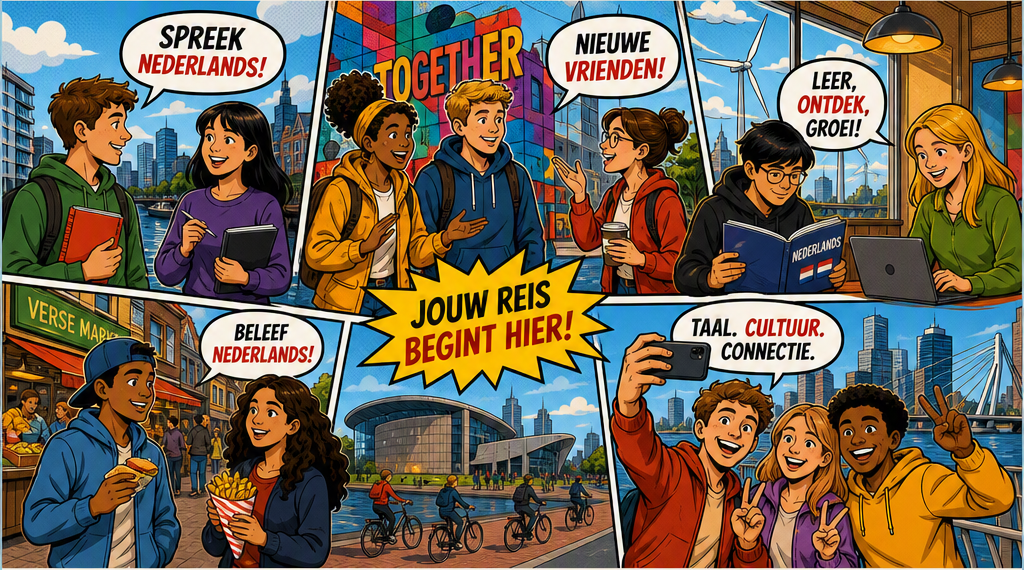
About This Course
Discover the joy of learning Dutch through the U.S. State Department’s premier Dutch language and culture program, recognized as one of the most effective and immersive courses available. This nationally acclaimed program doesn’t just teach vocabulary and grammar—it opens the door to a rich cultural experience that connects you with Dutch‑speaking communities both locally and abroad. And with the opportunity to earn up to 16 college credits from New York University, your learning journey can advance your academic and professional goals while deepening your cultural understanding.
Dutch is a language of creativity, innovation, and connection. Spoken across the Netherlands, Belgium, Suriname, and parts of the Caribbean, it bridges continents and cultures. Through this course, you’ll gain practical communication skills—speaking, listening, reading, and writing—while exploring the traditions, humor, and worldview that make Dutch culture so distinctive. You’ll learn to navigate everyday conversations, appreciate Dutch art and literature, and understand the social values that shape one of the world’s most progressive societies.
But the real magic happens when you bring your learning into your local community of native speakers. Across the United States, Dutch heritage thrives in cultural centers, historical societies, and family‑run businesses. By engaging with these communities, you’ll practice your language skills in authentic settings—sharing stories, volunteering at festivals, and building friendships that make the language come alive. You’ll find that speaking Dutch transforms ordinary encounters into meaningful exchanges.
This course also connects you to a global network of opportunity. The Netherlands is a leader in sustainability, design, and international trade. Knowing Dutch gives you access to collaborations, internships, and cultural exchanges that expand your horizons. Whether you’re pursuing international relations, art history, business, or simply personal enrichment, Dutch fluency adds depth and distinction to your profile.
By the end of the program, you’ll not only speak Dutch—you’ll think Dutch. You’ll understand the concept of gezelligheid—that warm, communal feeling of belonging—and you’ll carry it into your daily life.
Enroll today in the U.S. State Department’s best Dutch learning course. Earn up to 16 NYU credits, connect with native speakers, and discover how learning Dutch can make your world—and your community—richer, warmer, and more connected.
Course Staff
Chief Educational Troublemaker
Michael Williams
Michael Williams is the Chief Educational Troublemaker at World Mentoring Academy — a title he earned the hard way: by spending more than a decade poking, prodding, and occasionally drop‑kicking the traditional education system into the future. In 2010, long before “MOOC” became a Silicon Valley buzzword, Michael was building a free global college from a backpack, a stubborn belief in open learning, and whatever Starbucks Wi‑Fi he could borrow. The Orange County Register profiled him as a “homeless by choice educator to the world,” documenting his 12‑hour days assembling university‑level courses from MIT, Yale, NPTEL, and Stanford — all without charging a cent.
While the big platforms eventually traded “open” for “subscription,” Michael never budged. World Mentoring Academy remains one of the last true free MOOCs on Earth, offering more than 1,000 courses without paywalls, upsells, or fine print.
Michael’s LinkedIn essays — including “Harvard & MIT, Follow a Homeless Educator,” “The Future Won’t Wait for Academia,” and “Future of Education May Have Ancient Roots?” — have earned him a reputation as a futurist with calluses, someone who can explain why AI is breaking the job market, why teens are the workforce pipeline no one is using, and why the next education revolution will look more like ancient Athens than a modern lecture hall.
Across every WMA course, Michael appears as your unofficial guide, mentor, instigator, and occasionally your friendly academic arsonist — the guy who hands you the map, the compass, and the confidence to build a future that doesn’t depend on debt, gatekeeping, or waiting for institutions to catch up.
He helps learners find their place in a world that’s changing faster than universities can update their syllabi — and he does it with humor, humanity, and a refusal to accept that opportunity should be rationed.
If education needs a troublemaker, Michael is happy to volunteer.