About This Course
Unlock the world of live theatre — not just as an audience member, but as a creator. This course invites students, community members, and lifelong learners to explore theatre in all its forms: comedy, musical theatre, diverse cultural traditions, and the essential design elements that bring a production to life. Whether you’re fascinated by acting, directing, producing, stagecraft, or simply curious about how theatre works, this course opens the door to a vibrant artistic community waiting for you.
You’ll journey through the foundations of dramatic storytelling, from Shakespearean mistaken identity to modern satire. You’ll discover how musical theatre evolved from ballad opera and vaudeville into the Broadway spectacles we know today. You’ll meet groundbreaking artists like James Baldwin, Lorraine Hansberry, August Wilson, and Amiri Baraka — voices who reshaped American theatre and expanded its cultural reach. And you’ll gain a behind‑the‑scenes understanding of scenic design, costume creation, lighting technology, and the collaborative artistry that makes a stage production possible.
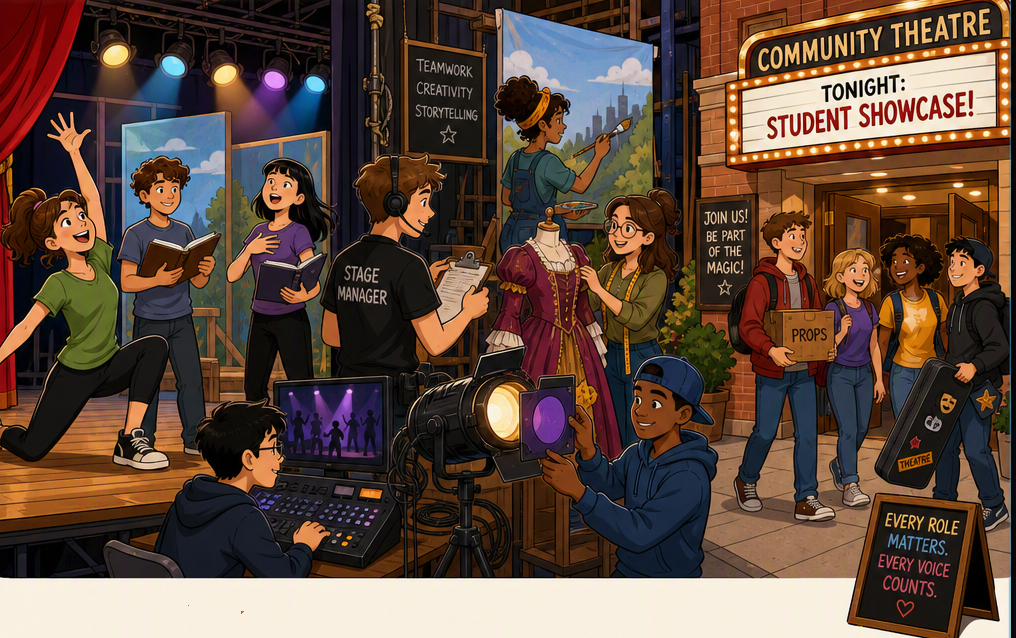
But this course isn’t just about learning — it’s about doing. Theatre thrives when people participate, and your local theatre needs you. Whether you want to act, build sets, run lights, sew costumes, usher, stage‑manage, or help produce community events, there is a place for every skill set and every personality. You don’t need prior experience; you only need curiosity and a willingness to try something new.
Local theatre is one of the most powerful engines of creativity and connection. It brings people together across backgrounds, generations, and perspectives. It gives communities a voice. It creates friendships, confidence, and unforgettable memories. And it offers opportunities to grow — artistically, socially, and professionally.
By the end of this course, you’ll understand theatre not just as entertainment, but as a living, breathing ecosystem of artists, designers, storytellers, and volunteers. You’ll see how every production — from a small black‑box show to a full musical — depends on people like you.
So take the next step. Join a local theatre. Audition for a role. Volunteer backstage. Help build a set. Try lighting design. Explore costume work. Become part of the creative energy that keeps theatre alive.
Your community’s stage is waiting — and you belong on it.
Course Staff
Chief Educational Troublemaker
Michael Williams
Michael Williams is the Chief Educational Troublemaker at World Mentoring Academy — a title he earned the hard way: by spending more than a decade poking, prodding, and occasionally drop‑kicking the traditional education system into the future. In 2010, long before “MOOC” became a Silicon Valley buzzword, Michael was building a free global college from a backpack, a stubborn belief in open learning, and whatever Starbucks Wi‑Fi he could borrow. The Orange County Register profiled him as a “homeless by choice educator to the world,” documenting his 12‑hour days assembling university‑level courses from MIT, Yale, NPTEL, and Stanford — all without charging a cent.
While the big platforms eventually traded “open” for “subscription,” Michael never budged. World Mentoring Academy remains one of the last true free MOOCs on Earth, offering more than 1,000 courses without paywalls, upsells, or fine print.
Michael’s LinkedIn essays — including “Harvard & MIT, Follow a Homeless Educator,” “The Future Won’t Wait for Academia,” and “Future of Education May Have Ancient Roots?” — have earned him a reputation as a futurist with calluses, someone who can explain why AI is breaking the job market, why teens are the workforce pipeline no one is using, and why the next education revolution will look more like ancient Athens than a modern lecture hall.
Across every WMA course, Michael appears as your unofficial guide, mentor, instigator, and occasionally your friendly academic arsonist — the guy who hands you the map, the compass, and the confidence to build a future that doesn’t depend on debt, gatekeeping, or waiting for institutions to catch up.
He helps learners find their place in a world that’s changing faster than universities can update their syllabi — and he does it with humor, humanity, and a refusal to accept that opportunity should be rationed.
If education needs a troublemaker, Michael is happy to volunteer.