About This Course
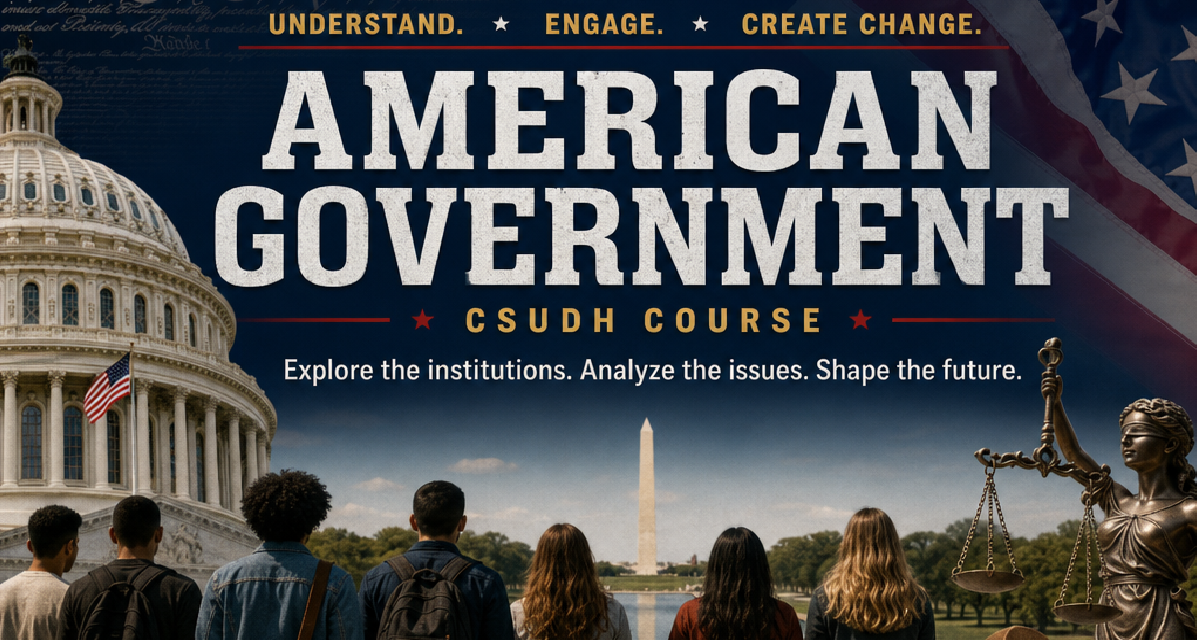
American Government (CSUDH) offers a deep, analytical look at how U.S. institutions confront the nation’s most pressing challenges. This course moves beyond textbook civics to examine the real tensions shaping American governance—where ideals of democracy meet the realities of policy, economics, and social change. Students engage in critical evaluation of major issues, conflicts, and problems that define the modern political landscape, exploring how government decisions ripple through communities, markets, and global systems.
Through lectures, readings, and case studies, learners analyze the structure and function of American institutions—Congress, the Presidency, the courts, and the bureaucracy—while assessing how these bodies respond to evolving public needs. The course emphasizes current issues such as social and health services, environmental regulation, energy policy, taxation, military spending, and the influence of multinational corporations. Each topic is approached through the lens of political economy and civil rights, encouraging students to question how power, resources, and representation are distributed across society.
Students develop the ability to interpret policy debates, evaluate competing perspectives, and understand the interplay between political ideology and institutional design. Discussions highlight how government choices affect everyday life—from healthcare access and environmental protection to criminal justice reform and economic inequality. The course also explores the role of citizens, advocacy groups, and media in shaping public opinion and influencing legislative outcomes.
Assignments and projects challenge learners to apply analytical frameworks to real-world scenarios, fostering skills in argumentation, evidence-based reasoning, and policy critique. By the end of the course, students will be equipped to engage thoughtfully with contemporary political issues, understanding not only what government does but why it does it—and how those decisions reflect deeper values and conflicts within American society.
This is a course for thinkers, reformers, and future leaders who want to understand the machinery of American democracy and the forces that drive it. It’s not just about studying government—it’s about learning to navigate, challenge, and improve it. #Government #American #Taxation #Economy #Political
Course Staff
Chief Educational Troublemaker
Michael Williams
Michael Williams is the Chief Educational Troublemaker at World Mentoring Academy — a title he earned the hard way: by spending more than a decade poking, prodding, and occasionally drop‑kicking the traditional education system into the future. In 2010, long before “MOOC” became a Silicon Valley buzzword, Michael was building a free global college from a backpack, a stubborn belief in open learning, and whatever Starbucks Wi‑Fi he could borrow. The Orange County Register profiled him as a “homeless by choice educator to the world,” documenting his 12‑hour days assembling university‑level courses from MIT, Yale, NPTEL, and Stanford — all without charging a cent.
While the big platforms eventually traded “open” for “subscription,” Michael never budged. World Mentoring Academy remains one of the last true free MOOCs on Earth, offering more than 1,000 courses without paywalls, upsells, or fine print.
Michael’s LinkedIn essays — including “Harvard & MIT, Follow a Homeless Educator,” “The Future Won’t Wait for Academia,” and “Future of Education May Have Ancient Roots?” — have earned him a reputation as a futurist with calluses, someone who can explain why AI is breaking the job market, why teens are the workforce pipeline no one is using, and why the next education revolution will look more like ancient Athens than a modern lecture hall.
Across every WMA course, Michael appears as your unofficial guide, mentor, instigator, and occasionally your friendly academic arsonist — the guy who hands you the map, the compass, and the confidence to build a future that doesn’t depend on debt, gatekeeping, or waiting for institutions to catch up.
He helps learners find their place in a world that’s changing faster than universities can update their syllabi — and he does it with humor, humanity, and a refusal to accept that opportunity should be rationed.
If education needs a troublemaker, Michael is happy to volunteer.